
Christmas Gift Exchange Without the Chaos: Simple Rules That Work

A simple Christmas gift exchange can keep the season thoughtful and joyful—without the stress of buying for everyone.
Christmas gift exchanges usually start with good intentions.
Then the family grows.
Siblings get married. Babies arrive. Children become teenagers. Adult kids start bringing partners. Some relatives live across the country. Everyone has a different budget, and suddenly buying a thoughtful gift for every person on the Christmas list feels less festive and more like a second job.
If your family has reached that point, you do not necessarily need to give up exchanging gifts.
You may simply need a better system.
The best Christmas gift exchange is the one everyone understands before anyone starts shopping.
That means deciding who is participating, how the exchange will work, how much everyone will spend, when gifts are due and what the rules are before names are drawn.
Here is how to create a family Christmas gift exchange that feels simpler, fairer and much easier to enjoy.
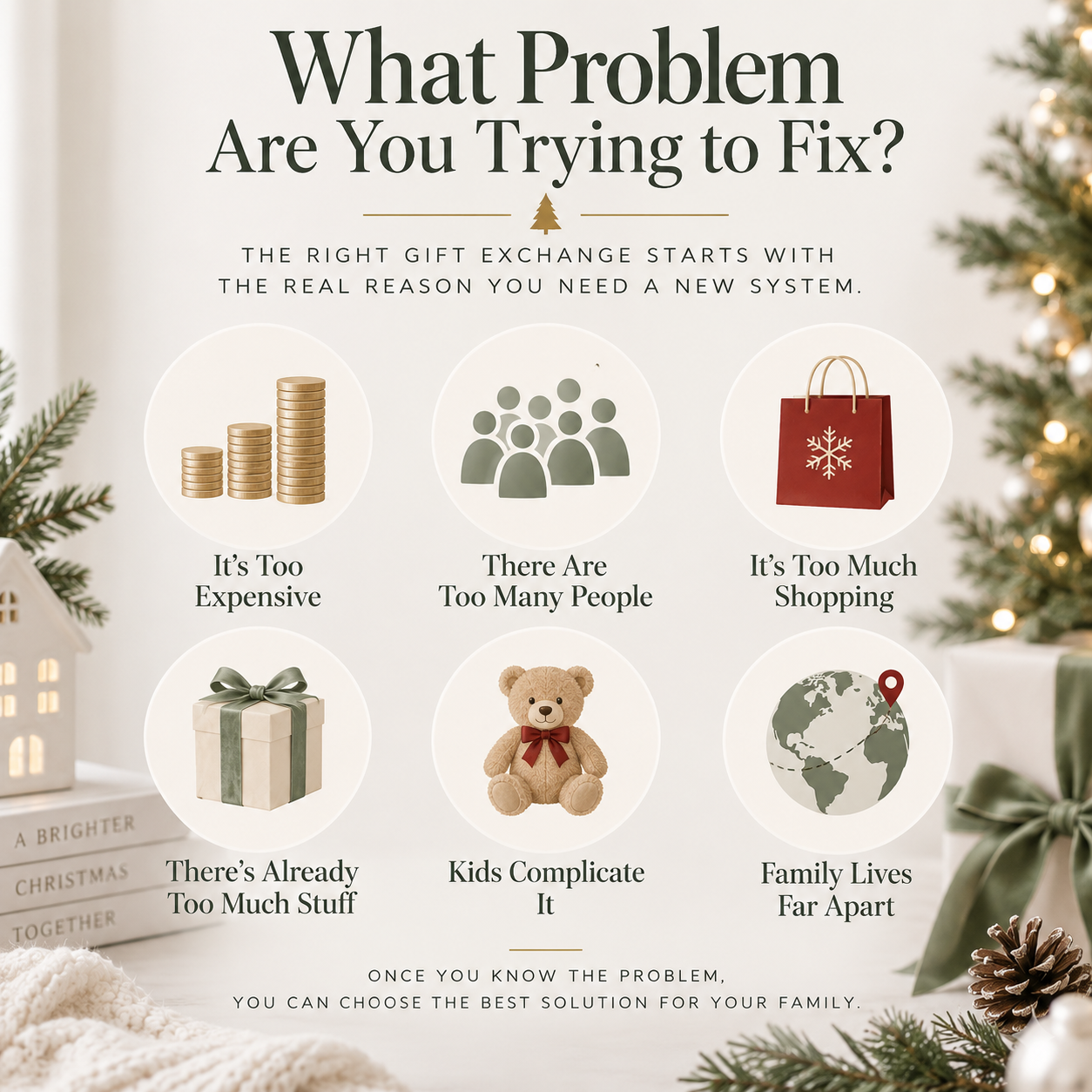
Before choosing Secret Santa, White Elephant, or another exchange, start with the real problem your family is trying to solve.
Before choosing Secret Santa, White Elephant or any other type of exchange, figure out what is actually making Christmas gifts difficult.
Maybe:
your family has become too large for everyone to buy for everyone
Christmas gifts are becoming too expensive
no one wants to shop for 15 or 20 people
the adults already have most of what they need
everyone is exchanging gift cards simply because they do not know what else to buy
children have dramatically increased the size of the Christmas list
family members live in different states
opening gifts takes half the day
people regularly receive things they do not want or need
some relatives would rather stop exchanging adult gifts altogether
Those are very different problems.
And they do not all require the same solution.
A family trying to reduce spending may need a simple name draw.
A family that wants Christmas morning to feel entertaining may prefer White Elephant.
A large extended family may be happiest letting the adults draw names while continuing to give normally to the children.
And some families may discover that they really do not want an adult gift exchange at all.
Start with the problem.
Then choose the exchange.
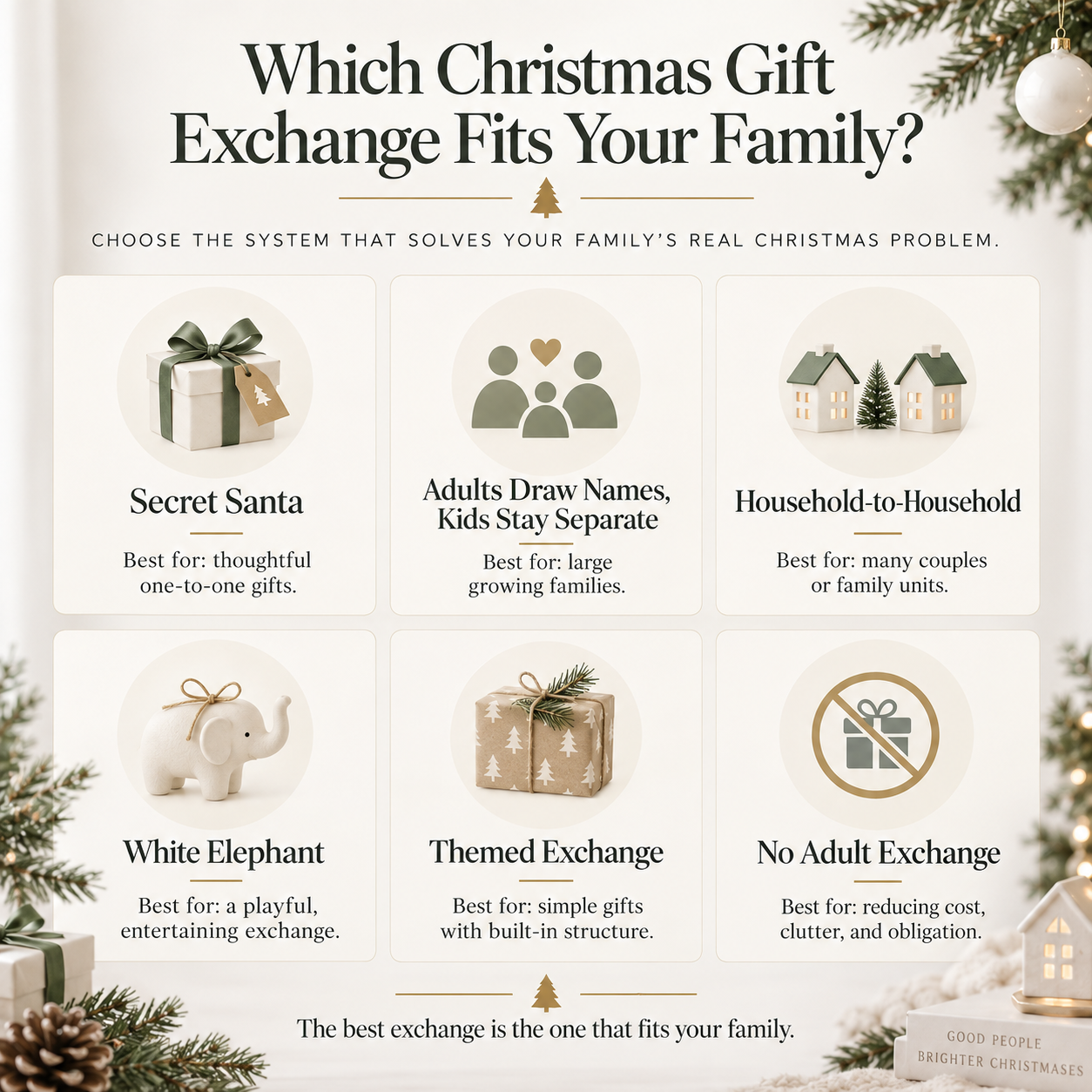
Choose the Christmas gift exchange that best solves your family’s real problem—from thoughtful Secret Santa gifts to a simpler no-adult-exchange approach.
There is no single “right” way to exchange Christmas gifts.
The best format depends on what your family wants the exchange to accomplish.
Secret Santa or Draw Names
Best for: families that still want thoughtful individual gifts but need to reduce the number of people everyone shops for.
Each person draws one recipient and buys only for that person.
This works especially well when your family still enjoys choosing personal gifts but buying for every adult has become unrealistic.
Secret Santa also gives you plenty of flexibility. You can use wish lists, set spouse exclusions, include long-distance relatives and choose whether the giver remains secret until Christmas.
Good choice if your main problem is: too many gifts to buy.
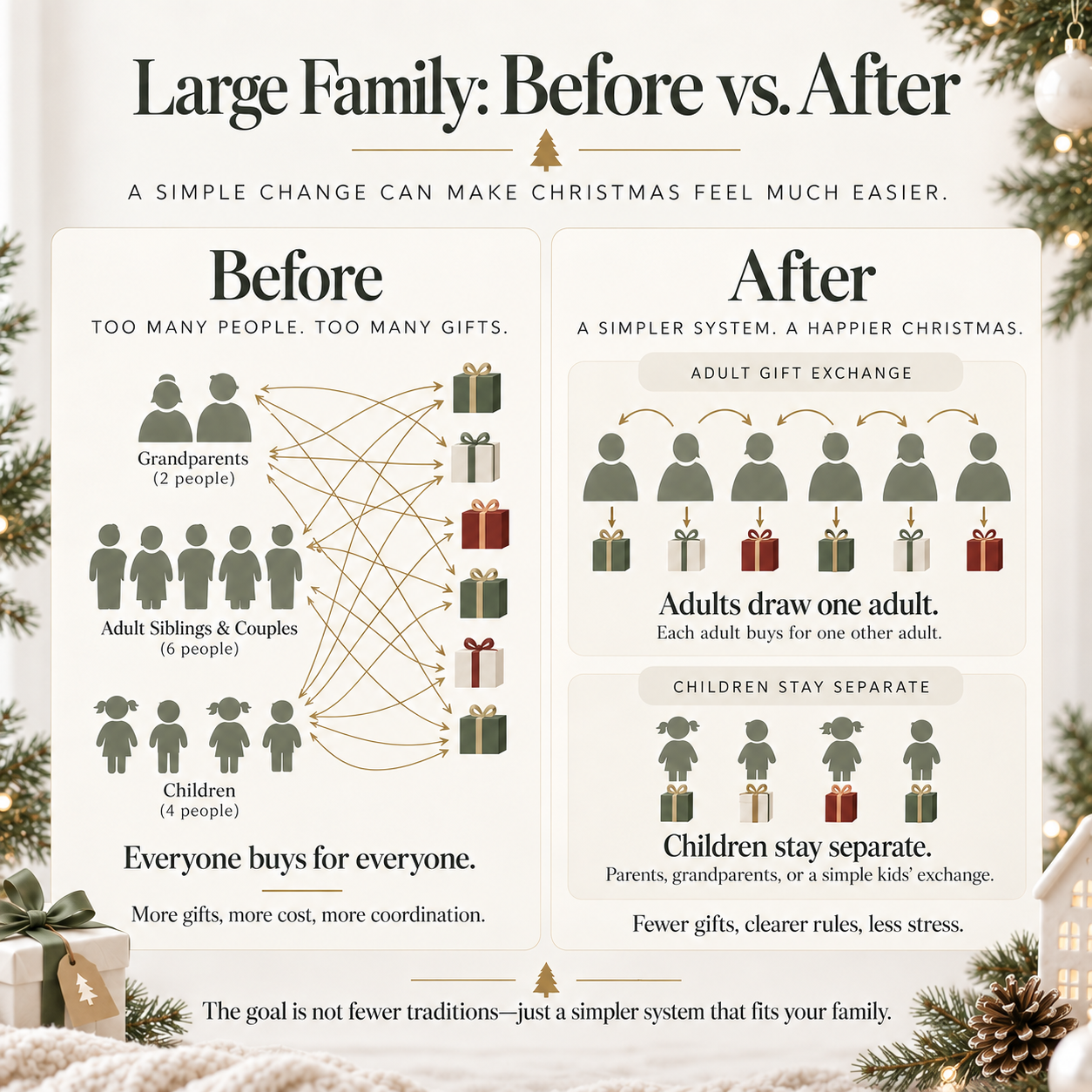
For a growing family, one simple change can make Christmas much easier: adults draw one adult name while children stay in a separate gift plan.
Best for: extended families that have grown because siblings now have spouses and children.
This is one of the simplest ways to preserve Christmas gifts for the kids without expecting every adult to buy for every other adult.
For example:
Instead of 12 adults buying gifts for all 11 other adults, each adult draws one adult name.
The children remain outside the adult exchange and receive gifts according to whatever tradition the family chooses.
That might mean grandparents buy for all grandchildren while aunts and uncles do not.
Or each household may continue giving to nieces and nephews.
There is no universal rule.
The important part is deciding it clearly.
Good choice if your main problem is: your family has grown dramatically.
Household-to-Household Gift Exchange
Best for: families with lots of couples, siblings and established households.
Instead of drawing individual names, each household draws another household.
One family might give to your sister, her spouse and their children as a group.
Your sister's family might draw another household.
This can reduce an enormous extended-family Christmas list to just one gift or small collection of gifts per household.
It also works well for gifts meant to be enjoyed together, such as:
a family game
movie-night basket
restaurant gift card
breakfast basket
Christmas treats
family experience
something useful for the home
Good choice if your main problem is: there are simply too many individual people.
White Elephant or Yankee Swap
Best for: families that want the gift exchange itself to be part of the entertainment.
Everyone brings one wrapped gift within the agreed budget.
Players choose gifts, open them and—depending on your rules—may steal gifts that have already been opened.
White Elephant is much less about choosing the perfect present for one particular person.
The fun is the exchange itself. If your family likes turning Christmas into part celebration and part game night, you may also enjoy these family Christmas games for kids, adults and everyone.
That makes it a great choice for groups where everyone enjoys a little unpredictability and laughter.
It is not always the best choice for a very large family, however. Once dozens of people are choosing, stealing and re-stealing gifts, the game can drag on.
If your family's biggest goal is reducing shopping rather than creating an activity, Secret Santa may be simpler.
Good choice if your main problem is: you want one shared exchange instead of individual gift giving.

A themed gift exchange gives everyone a little direction while keeping the budget simple, the shopping easier, and the gifts feeling thoughtful.
Best for: families that like giving gifts but want more structure.
Instead of everyone wondering what to buy, choose one category.
For example:
ornaments
books
cozy gifts
homemade gifts
favorite things
local gifts
Christmas treats
something under $20
You can combine a theme with either Secret Santa or White Elephant.
A themed exchange also makes a lower budget feel intentional rather than restrictive.
Good choice if your main problem is: everyone struggles to decide what to buy.
No Adult Gift Exchange
Best for: families that are ready to simplify Christmas even further.
You are allowed to decide that the adults do not need to exchange gifts.
That might mean:
gifts for children only
grandparents buy for grandchildren
everyone brings food instead
one family experience replaces gifts
adults simply enjoy being together
Choosing not to exchange adult gifts does not mean your family suddenly cares less about Christmas.
Sometimes it simply means the tradition no longer fits the family you have now.
Good choice if your main problem is: obligation has replaced enjoyment.
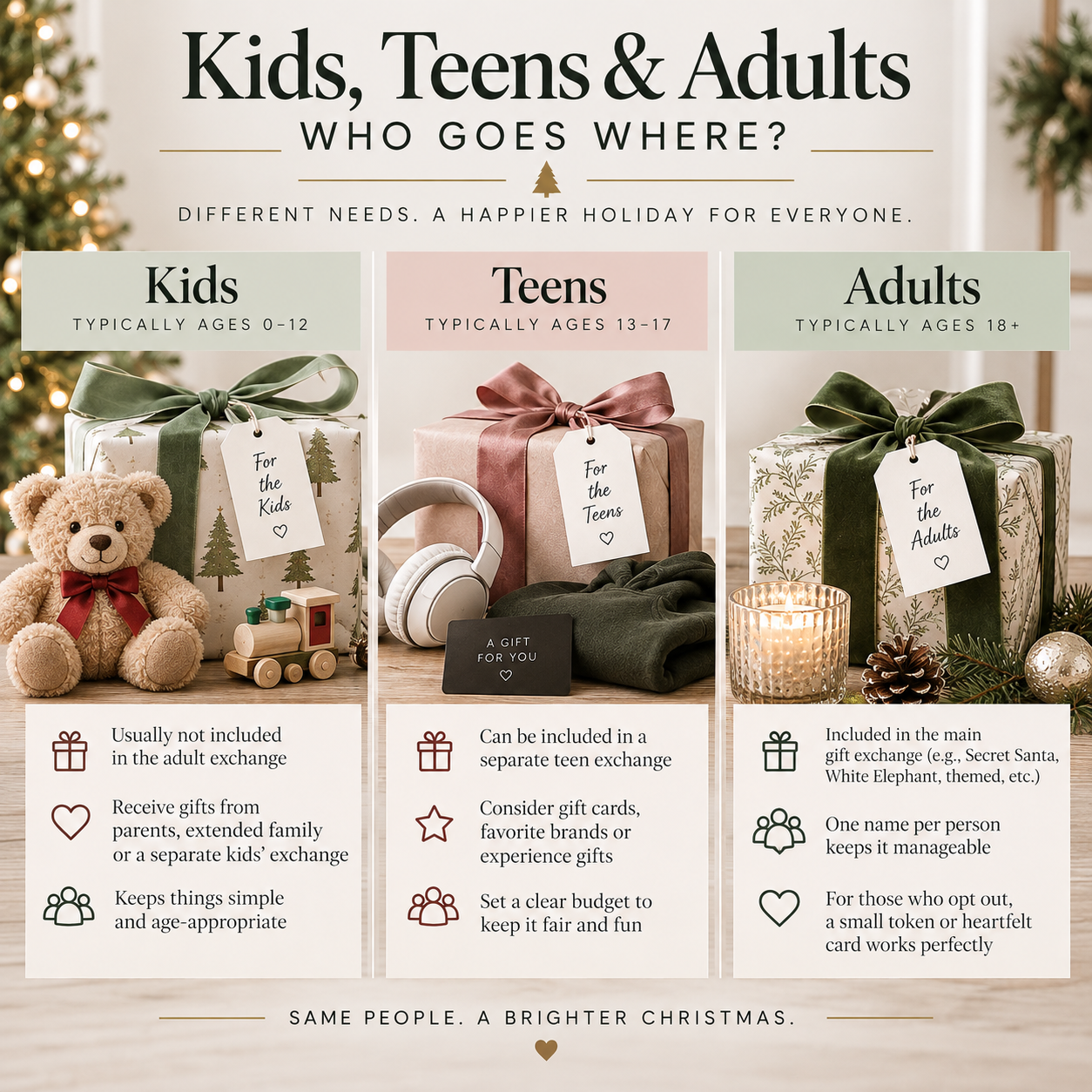
Kids, teens, and adults do not all have to follow the same gift-exchange rules. A simple age-based plan can keep Christmas fair, manageable, and enjoyable for everyone.
This is where many gift exchanges become confusing.
“Let's draw names this year” sounds simple until someone asks:
Does that include the kids?
What about teenagers?
Do spouses participate separately?
What about Grandma?
Are the cousins included?
Does my daughter's boyfriend participate?
Do people who live out of state draw names too?
Before creating the exchange, write down exactly who is included.
You may decide:
Adults only
or
Adults and teens 16 and older
or
Every adult draws one adult while children receive gifts separately
or
Every household participates as one unit
Any of those systems can work.
Ambiguity is what causes problems.
What About Couples?
Couples can participate individually.
If they do, decide whether spouses are allowed to draw one another.
Many families exclude spouses because the couple will already exchange gifts privately.
That keeps the family exchange focused on someone outside the household.
Other families do not mind spouses drawing each other.
Neither system is wrong.
Just decide beforehand.
What About Children?
Children do not have to follow the same system as adults.
A large family might decide:
Adults: draw one adult name.
Children: grandparents continue buying for grandchildren.
Or:
Adults: one Secret Santa gift.
Children: cousins draw names among themselves.
Teenagers can join either group depending on your family.
Do not make the exchange more complicated just to make every age follow identical rules.
And if you're keeping the children outside the adult exchange, you can still make their part of the holiday feel especially memorable with a few simple Christmas traditions for kids.

A fair Christmas gift exchange starts with a budget everyone can comfortably afford—and clear expectations about what that limit means.
A budget is supposed to make the exchange easier.
It should not quietly make someone anxious about participating.
Instead of asking:
“What's a nice amount for a Christmas gift?”
ask:
“What amount can everyone in this exchange comfortably spend?”
For one family that might be $25.
For another it might be $50.
There is no perfect number.
What matters is that everyone understands what the number means.
For example:
$30 maximum
is clearer than:
around $30
A maximum means no one is expected to spend more.
A range such as $25–$30 can also work if your family prefers everyone to stay relatively close in value.
What If One Person Wants a $100 Limit and Someone Else Can Only Spend $25?
Choose the lower amount.
The exchange should be designed around the amount that allows everyone to participate comfortably—not the amount the highest spender would enjoy.
Someone who wants to spend more can always give additional private gifts outside the exchange.
What If Someone Goes Over the Limit?
Do not turn Christmas morning into budget enforcement.
Instead, make the expectation clear beforehand.
You might say:
“We're keeping gifts at $30 or less so this stays affordable for everyone.”
If someone chooses to spend $60 anyway, that does not create an obligation for their recipient—or everyone else—to match them.
The limit is there to set expectations, not to measure affection.
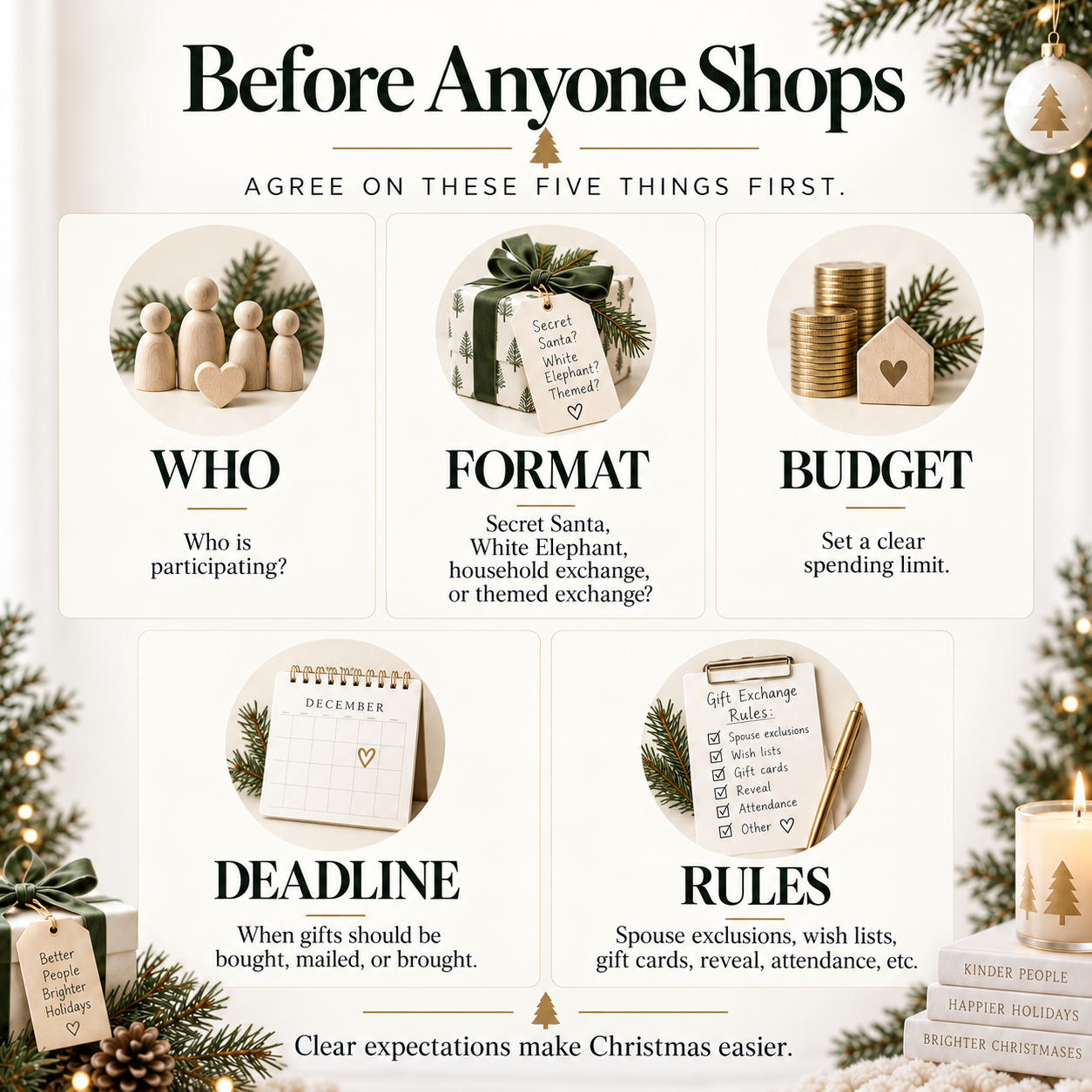
Before anyone starts shopping, agree on five things first: who is participating, the exchange format, the budget, the deadline, and the rules.
If your family remembers nothing else from this guide, remember:
WHO
Who is participating?
Adults? Kids? Teens? Couples? Households?
FORMAT
Secret Santa?
Adults-only draw?
Household exchange?
White Elephant?
Theme exchange?
BUDGET
What is the actual spending limit?
DEADLINE
When should gifts be purchased, mailed or brought?
RULES
Are spouses excluded?
Are wish lists allowed?
Can gift cards be given?
Will Secret Santa identities be revealed?
Will gifts be mailed if someone cannot attend?
If everyone knows those five things, you have prevented most of the confusion before it starts.
How to Draw Names Without Making Someone the Christmas Project Manager
You can absolutely put names in a bowl.
For a small family gathered together at Thanksgiving, that may be part of the fun.
But larger families often benefit from an online Secret Santa name-drawing tool.
Digital name draws are especially helpful when:
relatives live in different places
spouses should not draw one another
people need access to wish lists
someone forgets who they drew
participants join at different times
you need reminders
gifts will be shipped
The goal is not to make Christmas more technological.
It is to prevent one person from spending December answering:
“Who did I get again?”
Can You Do Secret Santa With an Odd Number of People?
Yes.
Secret Santa does not require pairs.
Seven people can participate just as easily as eight because each person gives to one person and receives from another.
Should You Use Christmas Wish Lists?
Wish lists can make family gift exchanges much easier.
They are especially helpful when:
relatives do not see each other often
teenagers are difficult to shop for
the family has a firm budget
people genuinely do not need more random things
the giver wants some direction without asking the recipient directly
The trick is to make the list helpful without turning Secret Santa into a shopping assignment.
Instead of listing one exact $50 item for a $50 exchange, give several ideas.
For example:
Favorite color: green
Coffee or tea: coffee
Hobbies: gardening and reading
Would love: candles, mystery novels, garden tools or cozy socks
Please skip: mugs
Now the giver still gets to choose.
Are Wish Lists Tacky?
Not if the family wants them.
A wish list is simply information.
It can actually make the exchange more thoughtful by preventing someone from spending money on something the recipient will never use.
Are Gift Cards Okay?
Usually, yes—especially when they are chosen with the recipient in mind.
A bookstore gift card for someone who reads constantly can be more personal than a random decorative item purchased simply because it fits the price limit.
But if every person is giving every other person an interchangeable $30 gift card, it may be worth asking whether your family still enjoys the exchange itself.
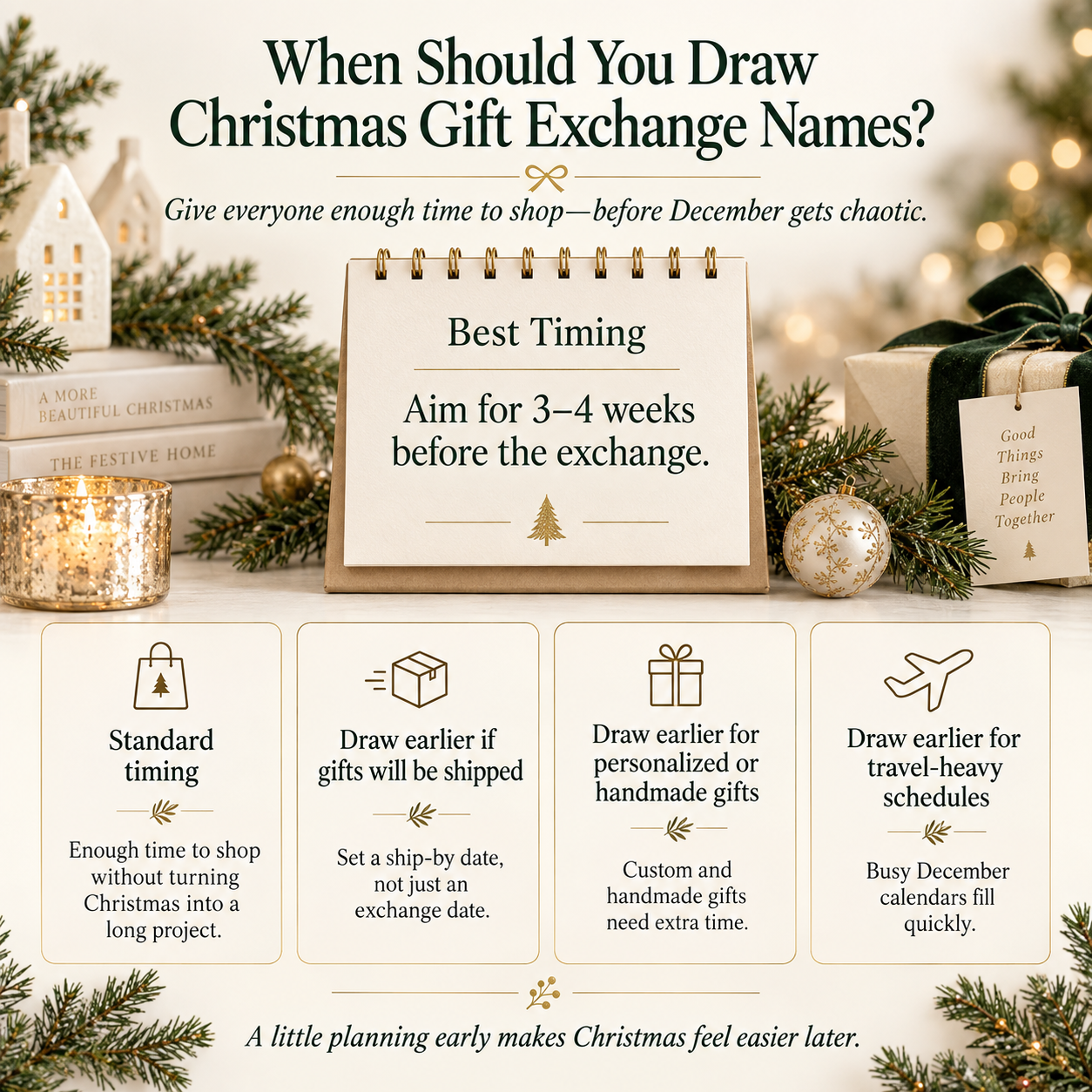
For most family gift exchanges, drawing names three to four weeks ahead gives everyone enough time to shop without letting Christmas planning drag on.
Give people enough time to shop without turning Christmas planning into a three-month project.
For most families, drawing names about three to four weeks before the exchange works well.
Draw earlier when:
gifts will be personalized
If personalized gifts are part of your exchange, this guide to personalized Christmas gifts to buy early can help with both ideas and timing.
relatives must ship gifts
people are traveling
handmade gifts are allowed
your family has a particularly busy December
A family gathering around Thanksgiving can also be a natural time to draw names for Christmas.
Whatever date you choose, set it before December becomes chaotic.
Set a Shopping or Shipping Deadline
“Bring your gift at Christmas” works when everyone lives nearby.
It is less helpful when relatives are mailing gifts from three states away.
For long-distance exchanges, set a ship-by date.
For example:
Please mail gifts by December 15.
That is more useful than simply saying:
Gifts are due December 24.
You may also want to decide:
whether shipping costs count toward the gift budget
whether gifts should be sent directly to the recipient or to the Christmas host
whether the recipient should wait to open the package
whether remote relatives will join the reveal by video
A little planning prevents the awkward Christmas-night question:
“Did your gift ever arrive?”
What If Someone Can't Attend Christmas?
Decide this before it happens.
For Secret Santa, the simplest rule is:
If you cannot attend, your gift still goes to your recipient.
You can mail it, send it with another relative or arrange delivery ahead of time.
Their giver can do the same.
For White Elephant, it is usually easier to limit participation to people who will actually be present because the exchange depends on everyone choosing and stealing gifts during the game.
How to Run a Secret Santa Exchange on Christmas
Once the planning is done, Secret Santa should be wonderfully simple.
Everyone brings one wrapped gift for the person they drew.
Put the recipient's name on the gift.
Gather everyone together.
Open gifts one at a time or all together.
Reveal the Secret Santas afterward if your family enjoys the guessing.
You can also let each recipient guess who chose their gift before the giver reveals themselves.
There is no requirement that Secret Santa remain secret forever.
The secret part is simply part of the fun.
Simple Family Secret Santa Rules
If your family wants something you can copy into the group chat, use this:
Family Secret Santa Rules
Everyone draws one person.
Each person buys one gift for the person they draw.
Spending limit: $____.
Spouses/partners: allowed or excluded.
Wish lists: allowed or not used.
Names will be drawn by: ____.
Gifts should be purchased or mailed by: ____.
If you cannot attend, send your gift with someone or mail it.
Put the recipient's name on the gift.
Secret Santas will be revealed after gifts are opened.
Simple rules are usually better rules.
How to Run a White Elephant Exchange Without It Taking Forever
White Elephant is supposed to be fun.
The easiest way to ruin it is to create so many rules that nobody understands what is happening.
Keep it simple.
Everyone brings one wrapped gift within the agreed budget.
Put all gifts together.
Everyone draws a number.
Number one chooses and opens a gift.
Number two can open a new gift or steal an opened gift.
Continue in number order.
Limit how many times one gift can be stolen.
Once a gift reaches the steal limit, it is frozen.
For a large group, consider limiting each gift to two steals.
That keeps the exchange moving.
Secret Santa or White Elephant?
Choose Secret Santa when you want the gift to feel personal.
Choose White Elephant when you want the exchange to feel like an activity.
That one distinction makes the decision much easier.
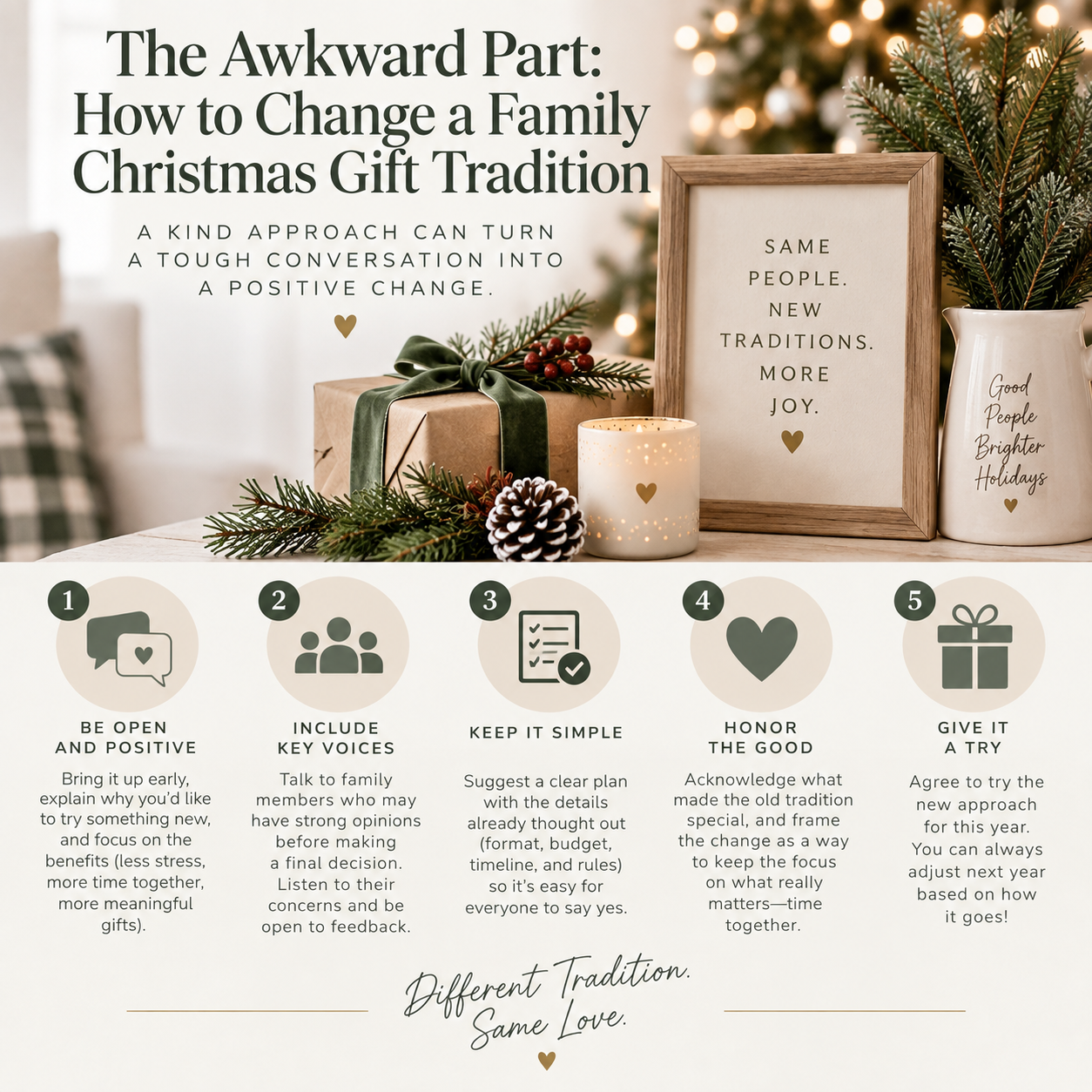
Changing a family Christmas tradition can feel awkward, but a kind conversation, clear plan, and focus on what matters most can make the transition much easier.
Sometimes creating the new exchange is not the difficult part.
Suggesting it is.
Families can become attached to Christmas traditions even when those traditions no longer work particularly well.
So instead of announcing:
“We're not buying everyone gifts anymore.”
frame the conversation around making Christmas easier for everyone.
You might say:
Our family has gotten so big, and buying for everyone is becoming a lot. What would everyone think about drawing one adult name this year and keeping the kids separate? We could set a comfortable budget so everyone still gets something thoughtful without having so much shopping to do.
That feels very different from criticizing the old tradition.
It invites the family to solve the problem together.
Copy-and-Send Family Gift Exchange Message
Here is a version you can adapt for your family group chat:
Christmas has gotten wonderfully big around here, but that also means we're all buying for a lot of people. Would everyone be open to simplifying gifts this year?
I thought we could have the adults draw one name each with a $___ limit, while keeping the kids' gifts separate. We can share a few wish-list ideas after names are drawn so everyone has some direction.
If everyone likes the idea, we'll draw names by ___ and have gifts ready by ___.
No pressure if someone would rather not participate—I just thought this might make Christmas a little easier and let us enjoy the day without so much shopping.
Adjust the details.
Keep the tone collaborative.
Can Someone Opt Out of the Family Gift Exchange?
Yes.
Gift exchanges work best when participation is voluntary.
Someone may be:
cutting expenses
simplifying Christmas
traveling
overwhelmed
uncomfortable with gift giving
simply uninterested
They do not need to justify that decision to the entire family.
The important logistical rule is:
Opt out before names are drawn whenever possible.
That prevents someone else from being left without a giver.
And if someone does opt out, the rest of the family can still continue with the exchange.
Is It Rude to Only Buy Christmas Gifts for the Children?
No universal Christmas rule says every adult relative must exchange gifts.
Families create their own traditions.
If buying for every adult has become expensive or unnecessary, “children only” can be a perfectly reasonable system.
What matters is communication.
The problem usually is not:
“We only buy for the kids.”
The problem is discovering on Christmas morning that half the family thought adults were exchanging gifts and the other half did not.
Decide early.
Tell everyone.
Then enjoy the tradition you actually chose.
What If Someone Still Buys Gifts for Everyone?
This happens.
Your family agrees to draw names, and one person still arrives with gifts for 18 people.
Let them.
Their generosity does not have to become everyone else's obligation.
You can appreciate the gift without deciding that the entire family agreement has failed.
The system is about what people are expected to do.
Someone can always choose to do more privately.
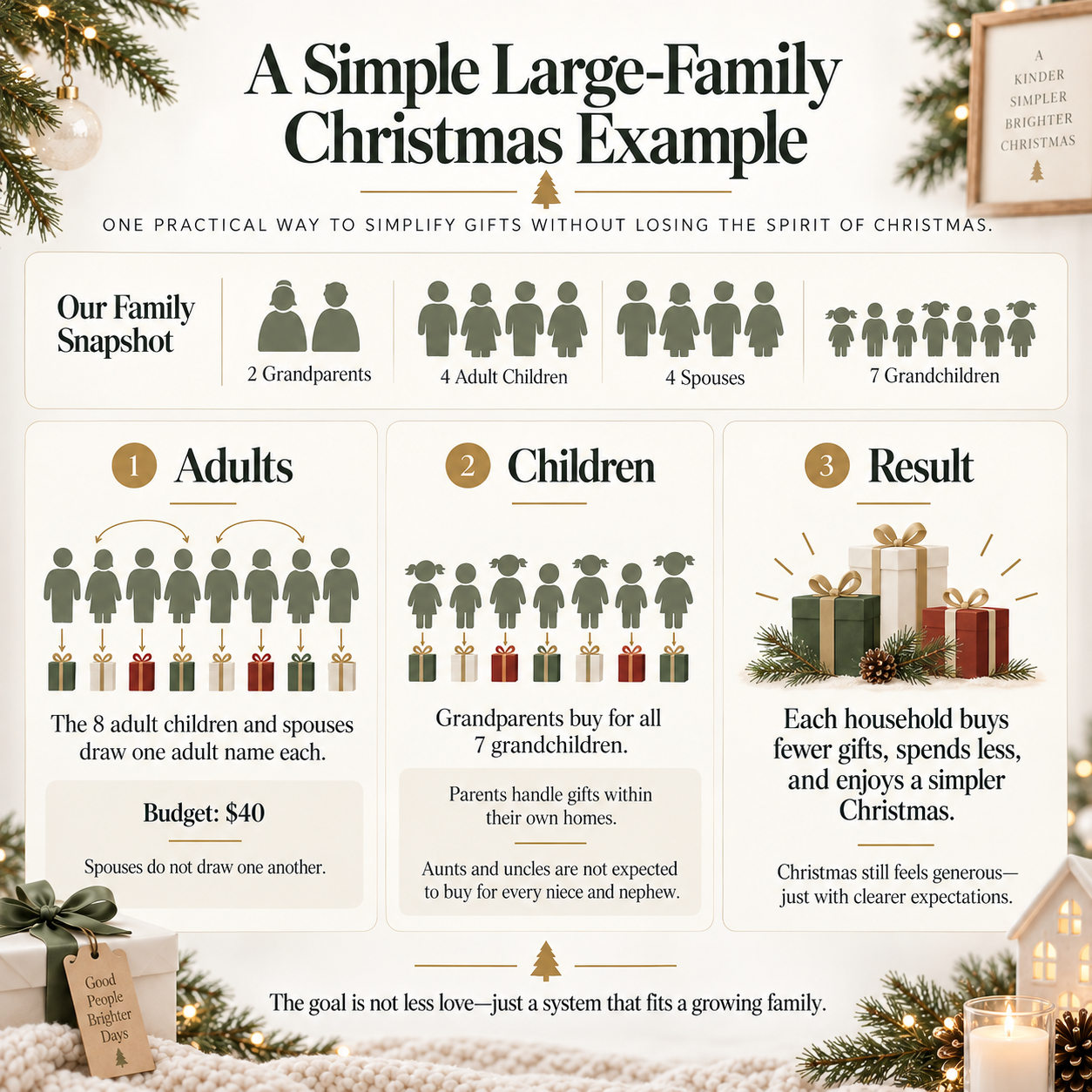
A large family can simplify Christmas without losing the joy: adults draw one adult name, grandparents buy for the grandchildren, and each household has far fewer gifts to manage.
Imagine this family:
Two grandparents.
Four adult children.
Four spouses.
Seven grandchildren.
Buying one gift for every person would mean a long list for almost every household.
Instead, they decide:
Adults
The eight adult children and spouses draw one adult name.
Budget: $40.
Spouses cannot draw one another.
Children
Grandparents buy for all seven grandchildren.
The parents handle gifts within their own homes.
Aunts and uncles are not expected to buy for every niece and nephew.
Result
Each adult household goes from shopping for a long list of extended-family members to purchasing only a few intentional gifts.
Christmas gifts still happen.
The family simply removes the expectation that everyone must buy something for everyone.
That is the kind of simplification a good gift exchange should create.
Your Christmas Gift Exchange Checklist
Before anyone starts shopping, make sure your family has answered:
WHO
Who is participating?
FORMAT
Secret Santa, household exchange, White Elephant or something else?
BUDGET
What is the maximum?
EXCLUSIONS
Can spouses draw each other?
DRAW DATE
When will names be assigned?
WISH LISTS
Are they allowed?
SHOP OR SHIP DATE
When should gifts be ready?
CHILDREN
Are they part of the exchange or separate?
ABSENCES
What happens if someone cannot attend?
EXCHANGE DAY
How will gifts actually be opened?
If you can answer all ten, your family Christmas gift exchange is essentially organized.
Frequently Asked Questions About Family Christmas Gift Exchanges
Can you do Secret Santa with an odd number of people?
Yes. Secret Santa does not require people to be paired. Each person gives to one recipient and receives from another, so an odd number works perfectly well.
Should spouses draw each other in Secret Santa?
They can, but many families exclude spouses because couples usually exchange gifts separately. Decide before names are drawn.
Should children participate in Secret Santa?
They can, but they do not have to. Large families often keep younger children outside the adult name draw. Teenagers can participate with adults or have their own exchange.
Are gift cards okay for Secret Santa?
Yes, particularly when the card is chosen for the recipient's interests. A gift card does not automatically make a gift impersonal.
What happens if someone forgets their Secret Santa gift?
If possible, quietly arrange for the recipient to receive the gift later rather than turning the mistake into part of the Christmas entertainment. If your family frequently has this problem, setting an earlier reminder or deadline can help next year.
What if someone drops out after names have already been drawn?
The organizer may need to redraw affected names or privately reassign the missing person's recipient. Digital name-drawing tools can make this easier.
Do you have to reveal Secret Santa identities?
No. Some families reveal everyone after opening gifts. Others enjoy keeping it secret. Decide whichever version sounds more fun to your group.
What is the difference between Secret Santa and White Elephant?
Secret Santa assigns each person a specific recipient and usually focuses on choosing a thoughtful gift for that individual.
White Elephant uses a shared pool of gifts that participants choose and steal during the exchange.
Think:
Secret Santa = thoughtful.
White Elephant = playful.

A simpler Christmas can still feel deeply special when clear expectations leave more room for kindness, connection, and time together.
Family traditions are supposed to serve the people participating in them.
Sometimes that means keeping the tradition exactly as it has always been.
Sometimes it means adjusting it as the family grows.
And sometimes it means admitting that buying gifts for every adult, spouse, cousin and child no longer makes sense.
A Christmas gift exchange can preserve the part everyone loves—the anticipation, the surprise, the thoughtfulness—while removing a great deal of the cost and stress.
You do not need the cleverest exchange.
You do not need complicated rules.
You simply need everyone to understand the same plan.
Who is participating.
What kind of exchange you are having.
How much everyone is spending.
When the gifts are due.
And what happens when Christmas arrives.
Decide those things before anyone shops, and Christmas suddenly becomes much easier.
However your family chooses to celebrate, I hope this helps make Christmas feel a little lighter, simpler, and more joyful.
The traditions we keep should bring us closer—not leave us feeling overwhelmed before the season even begins. Sometimes a few clear expectations are all it takes to make room for more laughter, more connection, and more of the moments we actually want to remember.
Wishing you a beautiful Christmas filled with people you love and traditions that truly fit your family.
Love,
Leska
Chateau Whispers
