
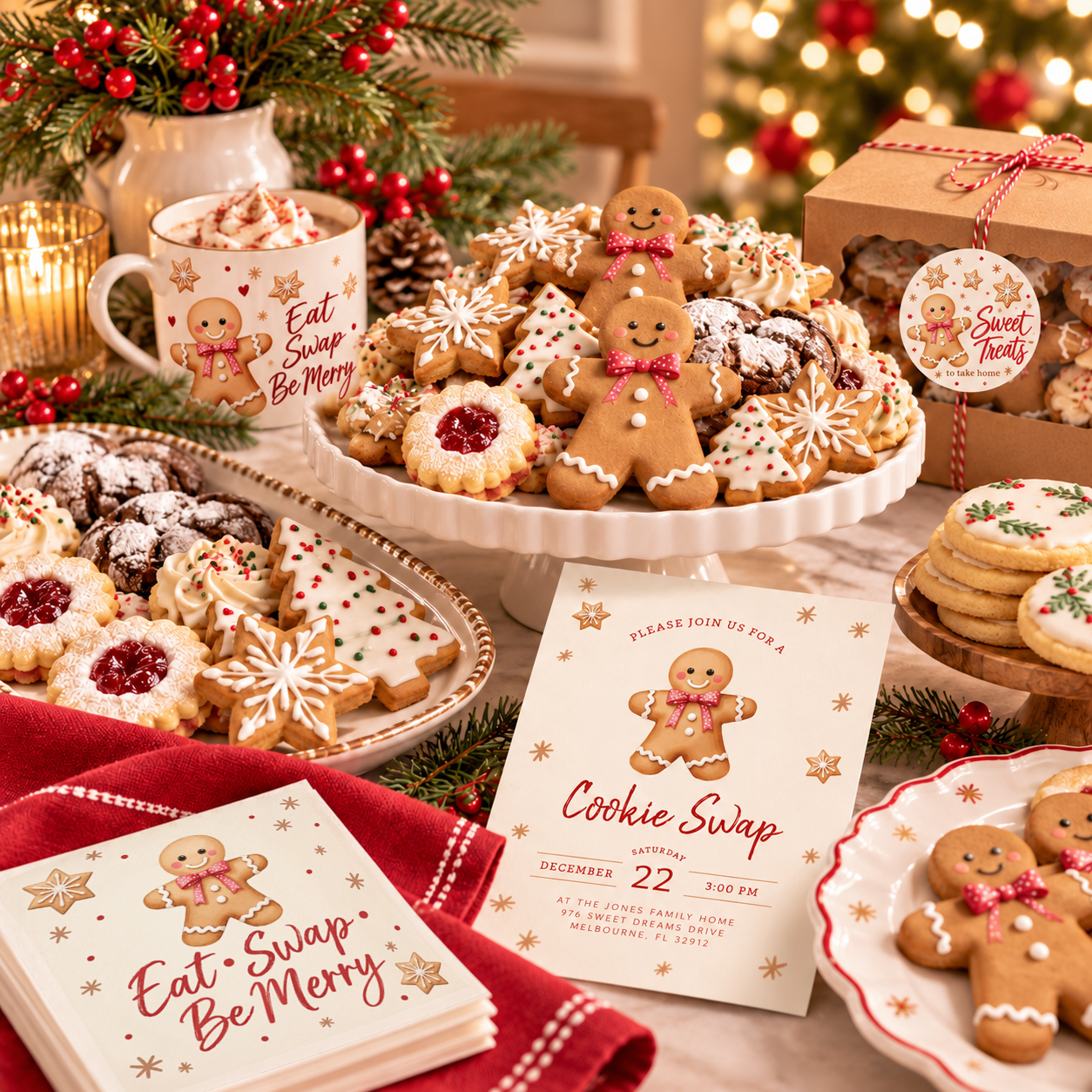
A festive Christmas cookie exchange table filled with holiday cookies, hot cocoa, take-home treats, and coordinating Gingerbread Cookie Exchange party details.
A Christmas cookie exchange sounds simple enough: everyone bakes cookies, brings them to the party, and goes home with an assortment.
And it really can be that simple.
The part that tends to cause confusion is everything that happens between “Let’s have a cookie swap!” and the moment everyone starts filling their boxes. How many cookies should each person bring? Should guests bring recipes? What happens if three people choose chocolate chip cookies? Who provides the boxes? Do you sample before you swap? How do you make sure one guest doesn’t accidentally take half the peppermint cookies before everyone else gets a turn?
A little planning solves almost all of it.
The easiest cookie exchanges are not the ones with the most elaborate decorations or the strictest rules. They are the ones where guests know exactly what to bring, the host has a simple plan for how the exchange will work, and everyone can relax and enjoy the afternoon.
Here is how to organize a Christmas cookie exchange from start to finish.
First, Decide What Kind of Cookie Exchange You Want to Host
Before you invite anyone, decide how you want the actual exchange to work.
There are two easy ways to do it.
A traditional pick-your-own cookie exchange
Everyone places their cookies on a shared table. Once it is time to swap, guests move around the table and choose an assortment to take home.
This is the format most people picture when they think of a cookie exchange, and it works especially well for a casual gathering of friends or family.
A pre-portioned cookie exchange
Each baker divides their cookies into equal portions ahead of time so every guest receives the same amount.
This can be useful for very large groups or when you want to make sure everyone leaves with an identical assortment, but it does require more preparation.
For most home cookie exchanges, the traditional pick-your-own version is easier and more fun. Guests can taste different cookies, talk about the recipes, and choose their favorites when it is time to pack a box.
How Many People Should You Invite to a Cookie Exchange?
For most homes, six to ten bakers is a comfortable range.
That gives you enough cookie varieties to make the exchange feel worthwhile without creating an enormous baking assignment for everyone.
A smaller group of four to six can still be lovely, especially if you want a relaxed gathering around the kitchen table. Once you move toward ten, twelve, or more bakers, you will need more display space, more take-home packaging, and a clearer plan for how many cookies each person should bring.
The important thing is not hitting a perfect number. It is choosing a group size that works for your space and then setting the cookie quantity accordingly.
How Many Cookies Should Everyone Bring?
This is one of the biggest cookie-exchange questions, and there is no universal number that works for every party.
You may see rules saying everyone should bring two dozen, three dozen, four dozen, or even one dozen cookies for every guest.
That last option can get out of hand quickly.
If eight people attend and everyone brings seven dozen cookies so that each guest can receive a dozen of every variety, you are suddenly dealing with 672 cookies.
That may be perfect for some groups. It is far more than most people need.
A better way is to decide how many cookies of each variety you want guests to take home.
A simple cookie-exchange formula
Think about:
the number of other bakers × the number of each cookie you want guests to receive + a few extras for tasting
For example, imagine you have eight bakers total.
There are seven other cookie varieties besides your own.
If you want everyone to take home about three of each variety:
7 varieties × 3 cookies = 21 cookies
Add another six to twelve for tasting and a little cushion, and three dozen cookies per baker is usually plenty.

A simple cookie exchange quantity guide helps you decide how many cookies each guest should bring based on the size of the group.
As a simple starting point:
Number of bakers Comfortable amount to bring 4–6 About 2 dozen 7–8 About 3 dozen 9–10 About 3–4 dozen 11–12 About 4 dozen
You can adjust that up or down depending on the size of the cookies and how generous you want the take-home assortment to be.
Most importantly, tell guests the exact quantity on the invitation. Do not make everyone guess.
Set the Cookie Exchange Rules Before You Send Invitations
Cookie-swap rules do not need to be complicated. They just need to be clear.
Before sending invitations, decide:
how many cookies each person should bring;
whether everyone should bake one cookie variety;
whether homemade cookies are required;
whether guests should bring a copy of their recipe;
whether common allergens should be identified;
whether guests should bring their own take-home container;
whether you want guests to tell you their cookie choice ahead of time.
That last one is especially helpful.
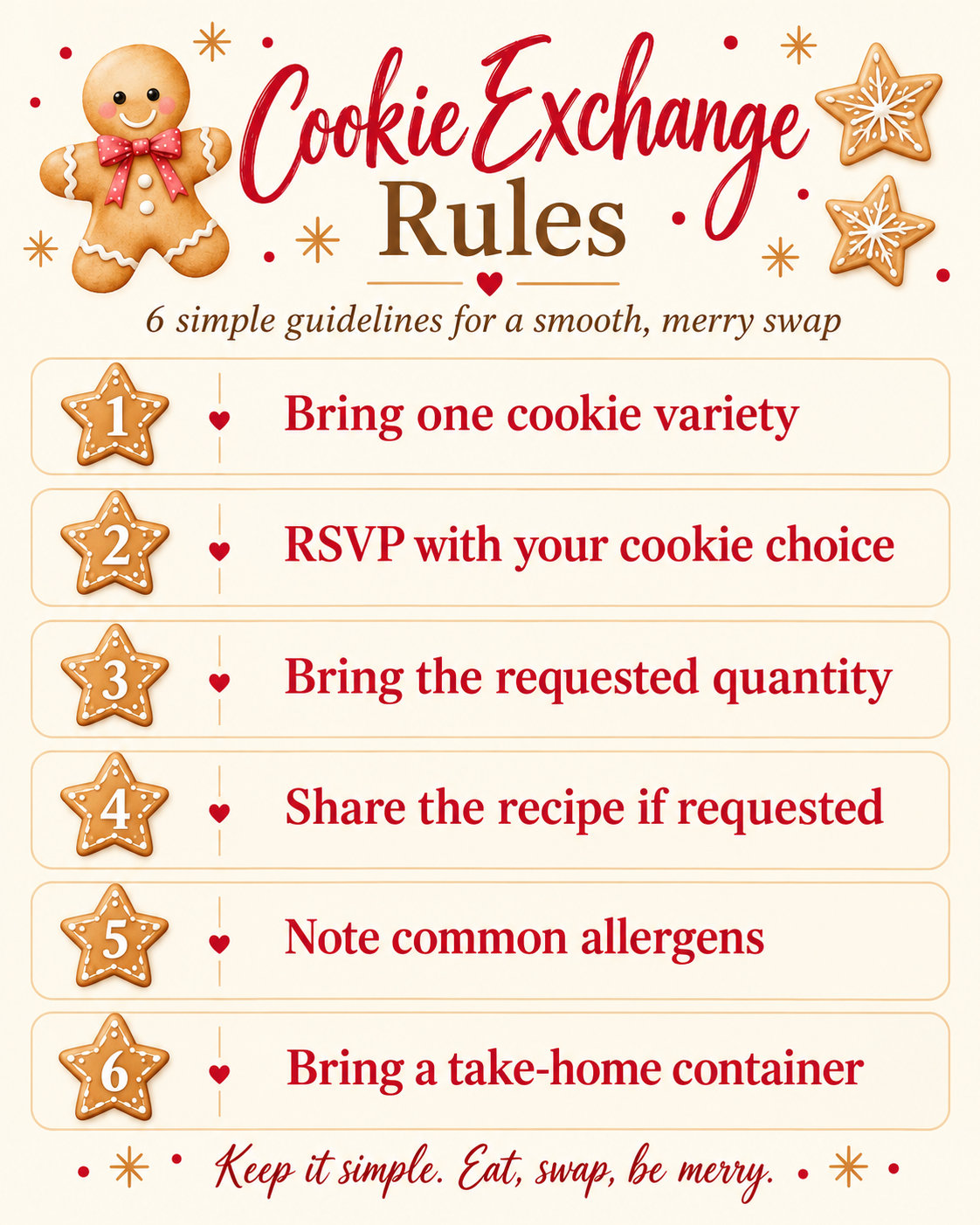
A few simple cookie exchange rules can make the party feel easy, organized, and fun for everyone.
If guests tell you what they plan to bake when they RSVP, you can avoid ending up with five plates of chocolate chip cookies and no gingerbread, shortbread, peppermint, jam-filled, or sugar cookies.
You do not need to control everyone’s recipe. You are simply looking for enough variety to make the exchange interesting.
And if your group is perfectly happy with store-bought cookies, that is fine too. Homemade is traditional, not mandatory. Your party gets to decide the rule.
What to Put on a Cookie Exchange Invitation
A cookie exchange invitation has to do a little more work than an ordinary Christmas party invitation because guests need to know what they are expected to bring.
At minimum, include:
date;
time;
location;
RSVP deadline;
how many cookies to bring;
whether cookies should be homemade;
whether guests should bring a recipe;
whether you would like allergy information;
whether guests should bring a take-home container;
and whether they should tell you which cookie they plan to bake.
That can be a lot of information to squeeze onto one invitation.
One easy solution is to keep the main invitation focused on the celebration and include the practical instructions on a coordinating details card.
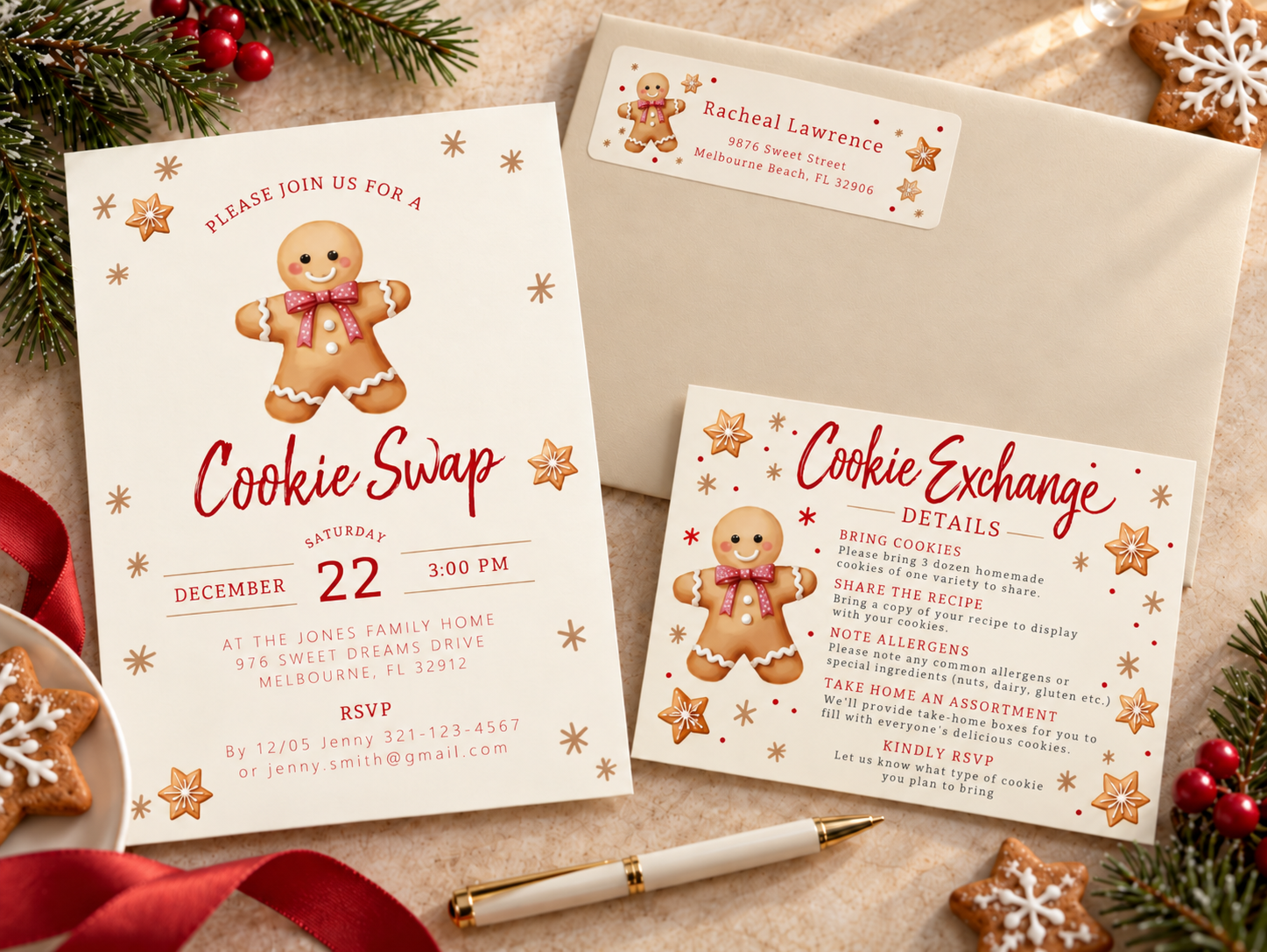
Keep the main invitation focused on the celebration, then use a coordinating details card for cookie quantities, recipes, allergens, and take-home instructions.
For example, your details might say:
Bring Cookies
Please bring 3 dozen homemade cookies of one variety to share.
Share the Recipe
Bring a copy of your recipe to display with your cookies.
Note Allergens
Please note any common allergens or special ingredients.
Take Home an Assortment
We’ll provide take-home boxes for you to fill with everyone’s delicious cookies.
Kindly RSVP
Let us know what type of cookie you plan to bring.
That gives guests everything they need without overwhelming the invitation itself.
Chateau Whispers note: This is exactly why we created a coordinating Cookie Exchange invitation and details card for our Gingerbread Cookie Exchange collection.
Ask Guests to Claim Their Cookie Variety
Once RSVPs begin coming in, keep a very simple list.
You only need four columns:
GuestCookieAllergy notesRSVP
As guests respond, write down what they are bringing.
This helps you spot duplicates early.
You do not need a perfectly curated dessert menu, but a little variety makes the swap much more fun. A group might naturally end up with:
chocolate cookies;
gingerbread or spice cookies;
sugar cookies;
peppermint cookies;
shortbread;
citrus cookies;
nut-based cookies;
jam-filled cookies.
If two people choose similar cookies, that is not automatically a problem. But if half the guest list plans to bring the same thing, you have time to gently ask whether anyone would like to switch.
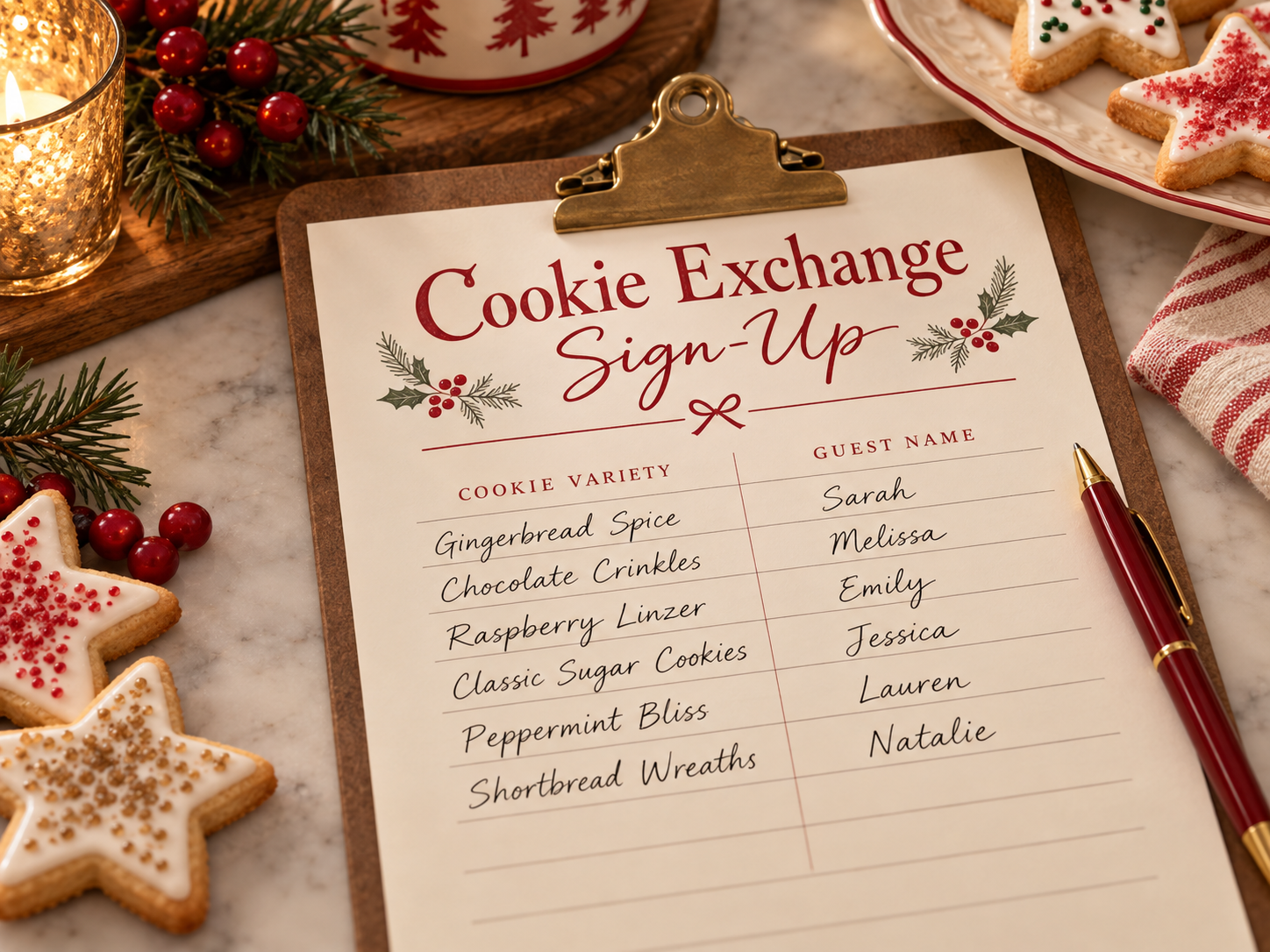
Free Cookie Exchange Sign-Up Sheet
Planning who’s bringing what? Download our free Cookie Exchange Sign-Up Sheet to keep track of each guest and cookie variety before the party.
Download the Free Sign-Up Sheet
Decide How You Will Handle Recipes and Allergens
Recipe sharing is one of the nicest parts of a cookie exchange because guests go home with more than a box of treats. They also leave with new recipes they may want to make again.
You have a few easy options.
Guests can bring a printed recipe
This is simple and gives everyone something tangible to keep.
Guests can fill out recipe sheets
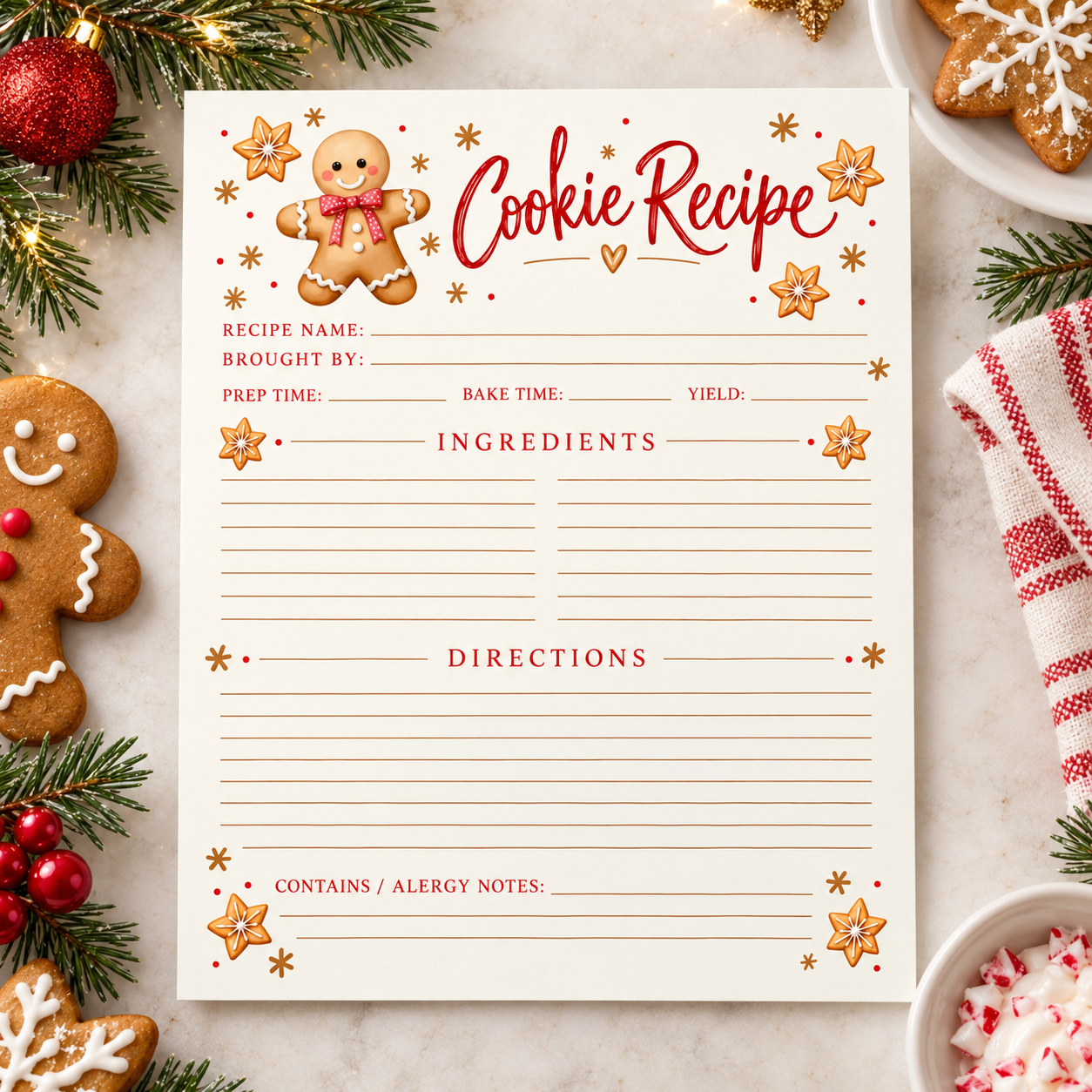
Your guests can share the recipes with everyone, find sheets here.
Set out coordinating recipe sheets and let each baker write down the recipe for their cookies.
Recipes can be shared digitally afterward
If you want to keep the party simple, collect recipes by email and send everyone the complete list after the exchange.
Whatever you choose, tell guests ahead of time so they arrive prepared.
What about allergens?
It is helpful to identify common ingredients such as:
nuts;
dairy;
eggs;
gluten;
or other ingredients guests may want to know about.
You can place a small card beside each platter with the cookie name, baker’s name, and allergy notes.
One important distinction: an ingredient card can communicate what a cookie contains, but it cannot guarantee that homemade food is safe for someone with a serious food allergy. Cross-contact can occur in home kitchens.
If a guest has a severe allergy, they should make their own decision about what is safe for them to eat.
This is where our Cookie Details cards and coordinating folded Cookie Exchange table cards can be especially useful.

Cookie exchange table cards help guests quickly see each cookie name, who brought it, and important allergen information. For a more detailed card click here
What Should the Host Provide?
A cookie exchange does not need to become a full dinner party.
In fact, one of the reasons this kind of gathering works so well during the holidays is that the cookies are already the main attraction.
The host should generally provide:
table or counter space for the cookie display;
serving platters if guests are not bringing their own;
small plates and napkins for tasting;
coffee, cocoa, tea, cider, water, or another simple drink station;
pens or markers;
cookie labels or table cards;
take-home boxes if that is what you promised on the invitation;
and basic cleanup supplies.
You do not have to serve an elaborate meal.
If your exchange takes place during lunchtime or dinner, you may want to add something savory, but for a mid-afternoon gathering, drinks and cookies can be plenty.
A cocoa or coffee station also gives guests something warm to sip while they taste the cookies.
How to Set Up the Cookie Exchange Table
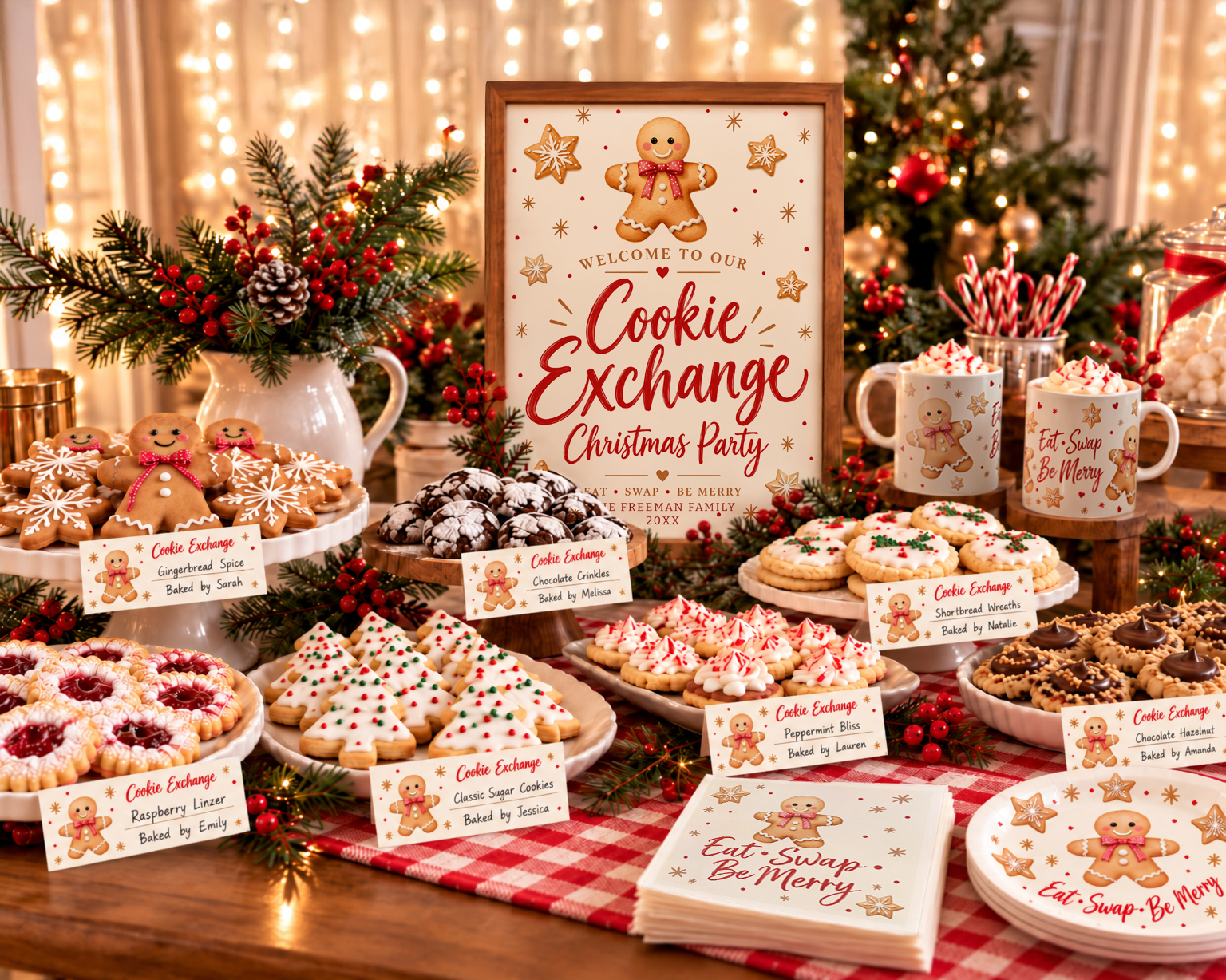
A well-organized Christmas cookie exchange table makes it easy for guests to browse, taste, and identify each cookie while keeping the party coordinated and festive.
The easiest way to keep the party organized is to think in zones.
1. Cookie display
Give each cookie variety its own space.
If possible, use one platter per baker.
Leave enough room for a small label in front of each platter.
2. Cookie information
Place a card beside each cookie with:
cookie name;
baker’s name;
allergy or ingredient notes if needed.
This prevents the inevitable:
“Whose cookie is this?”
“What kind is this?”
“Does this have nuts?”
3. Tasting area
Keep small plates and napkins nearby so guests can sample without immediately opening their take-home boxes.
4. Drink station
Coffee, hot cocoa, tea, cider, and water are all easy choices. A themed mug is a great addition to your celebration.
Keeping drinks slightly separate from the main cookie display also helps prevent a traffic jam around one table.
5. Packing station
Set aside another small table or counter for:
bakery boxes;
parchment or liners;
ribbon or twine if you want it;
pens.
This may seem like a small detail, but giving the packing station its own space makes the end of the party much easier.
A Simple 2-Hour Cookie Exchange Timeline
One of the most common planning questions is surprisingly basic:
When do we actually swap the cookies?
Here is a simple two-hour timeline that works well for most home gatherings.
0:00–0:20 — Arrive and set out cookies
As guests arrive, show them where to place their cookies and labels.
Give everyone time to settle in before beginning any organized activity.
0:20–0:50 — Drinks, tasting, and conversation
This is the relaxed part of the party.
Guests can sample cookies, get coffee or cocoa, compare recipes, and catch up.
0:50–1:05 — Optional voting
If you are doing a Crowd Favorite vote, this is a good time to collect ballots.
1:05–1:15 — Announce the winner
Count the votes and present the winner with a small award or keepsake.
1:15–1:40 — Swap cookies
Now everyone fills their take-home boxes.
1:40–2:00 — Finish packing and wind down
Guests can gather recipe cards, finish drinks, and pack anything remaining.
You can make this more casual or more structured depending on your group. The point is simply to have a general plan so you are not standing in the kitchen wondering whether people should start taking cookies yet.
How Does the Actual Cookie Swap Work?
When it is time to exchange cookies, explain the process before anyone starts filling a box.
For a traditional pick-your-own exchange, this works well:
Wait until all the cookies are displayed.
Tell guests approximately how many of each variety they should take during the first round.
Everyone moves around the table and chooses their assortment.
Once everyone has had a chance to go through, any remaining cookies are fair game.
This prevents one enthusiastic guest from taking eight peppermint cookies before someone else reaches the platter.
If you followed the cookie-count formula earlier, the math should already make this easy.
For example, if you planned for everyone to take three of each variety, simply tell guests:
“Take three of each cookie on your first trip around the table. Once everyone has gone through, feel free to grab extras.”
Done.

Set up a simple voting station with business-card-size ballots and a 5x7 crowd favorite certificate to make your cookie exchange even more fun.
Add a Crowd Favorite Vote — If Your Group Would Enjoy It
A cookie exchange does not need games or activities. The cookies and conversation are usually enough.
But a simple Crowd Favorite vote can be fun if your group enjoys a little friendly competition.
Give each guest one ballot and ask them to write:
My favorite cookie:
Baked by:
Collect the ballots after everyone has had time to taste.
Then announce the winning cookie before the exchange begins.
You do not need multiple categories unless you want them. One Crowd Favorite keeps it easy.
A small award card makes a nice keepsake for the winner—and gives everyone something to laugh about when the same baker inevitably starts planning their title defense for next year.
Set Up a Take-Home Cookie Packing Station

Set up a clearly marked cookie packing station so guests know exactly where to fill their take-home bags and boxes.
The take-home portion is one of the most satisfying parts of a cookie exchange, so make it easy for guests.
Set out:
bakery boxes;
parchment paper or liners;
stickers or labels;
ribbon or twine if desired;
pens.
If you are providing the boxes, assemble them before the party.
No one wants to spend the last twenty minutes of a Christmas gathering figuring out how cardboard tabs fit together.
A simple sign that says “Pack Your Cookies Here” also makes the station self-explanatory.
Guests can fill their boxes during the exchange, add a tag or sticker, and head home with an assortment that feels a little more special than a pile of cookies in a plastic bag.
What to Do After the Cookie Exchange
Once everyone has gone home, there usually is not much left to do.
Store any leftover cookies according to the recipe, share any missing recipes with the group, and send photos if you took them during the party.
If you enjoy sending a little extra note after hosting, a thank-you card is a lovely final touch—especially for a smaller gathering.
You can simply say:
Thank you for making our Cookie Exchange so sweet. We’re so glad you joined us for an afternoon of cookies, laughter, and holiday cheer.
It brings the event full circle from invitation to thank-you.
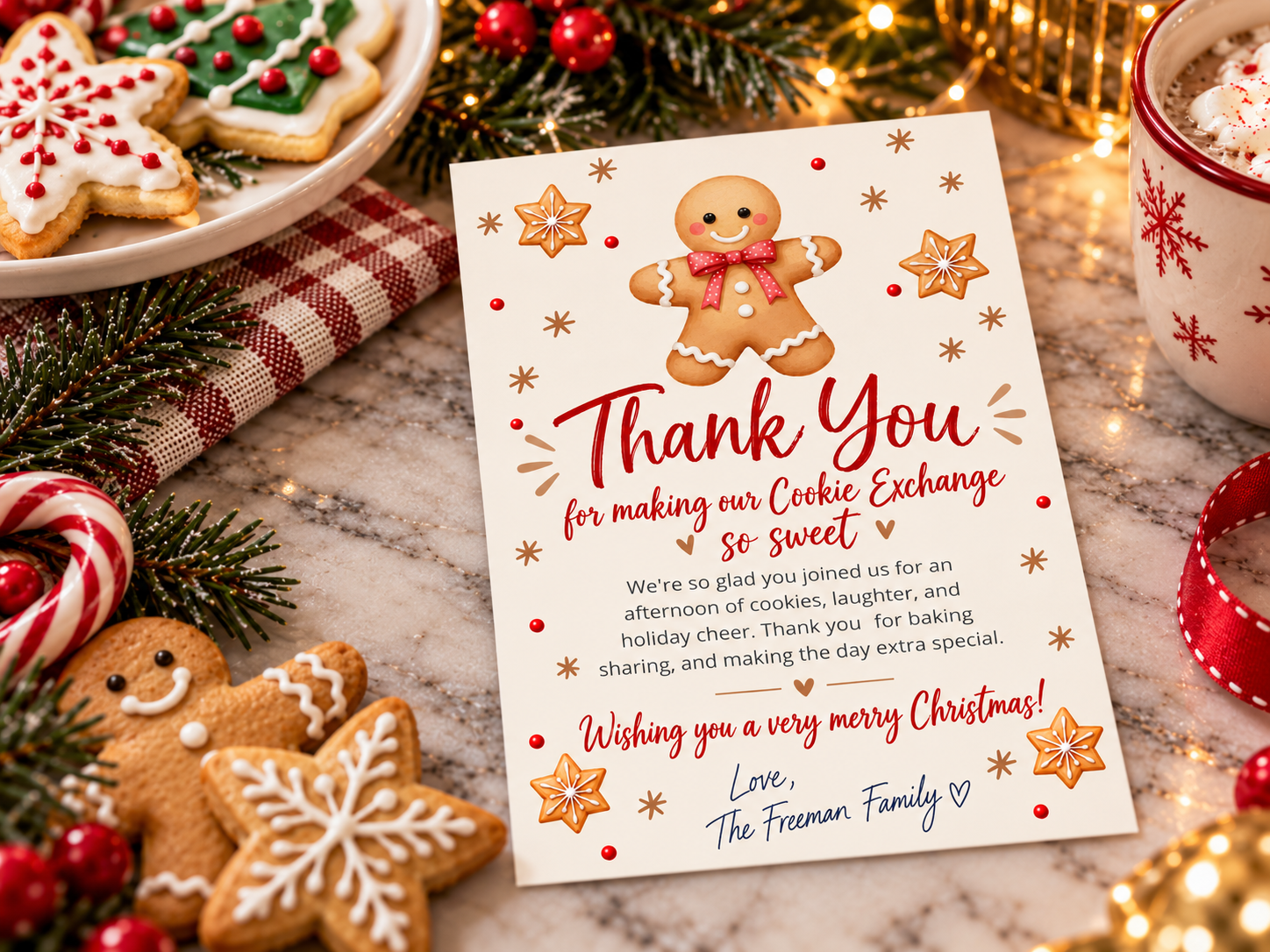
A handwritten thank-you card is a sweet finishing touch for a cookie exchange, giving the host one more chance to thank guests for baking, sharing, and celebrating together.
Christmas Cookie Exchange Checklist
Sometimes the easiest way to plan is simply to see everything in order.
2–3 Weeks Before
Choose the date and time.
Make your guest list.
Decide how many cookies everyone should bring.
Decide whether cookies must be homemade.
Decide how recipes and allergy notes will be handled.
Decide whether you or the guests will provide take-home containers.
Send invitations.
1–2 Weeks Before
Collect RSVPs.
Write down each guest’s cookie variety.
Watch for too many duplicate cookies.
Ask about any important dietary concerns.
Order or purchase take-home boxes.
Plan drinks.
Gather serving pieces.
1–2 Days Before
Assemble bakery boxes.
Prepare table cards and allergy cards.
Gather pens and markers.
Set aside plates and napkins.
Prepare the drink station.
Bake your own cookies.
Prepare voting cards if you are using them.
The Day of the Cookie Exchange
Set up the cookie table.
Create a tasting area.
Set up drinks.
Put cookie labels in place.
Create the packing station.
Set out ballots if you are voting.
Welcome your bakers.
Taste cookies.
Vote.
Swap.
Pack boxes.
Enjoy the fact that your Christmas baking just turned into an entire assortment.
Frequently Asked Questions About Cookie Exchanges
How many cookies should you bring to a cookie exchange?
It depends on the number of bakers and how many of each variety you want everyone to take home.
For many home exchanges, two to four dozen cookies per baker is plenty.
A good formula is:
number of other bakers × number of each variety you want guests to receive + tasting extras
Then tell guests the exact quantity on the invitation.
How many people should you invite to a cookie exchange?
About six to ten bakers works especially well for many home cookie exchanges.
Smaller groups are easier to manage, while larger groups give you more variety but require more cookies and table space.
Do all the cookies have to be homemade?
Only if you decide that is one of your party rules.
Homemade cookies are traditional, but there is nothing wrong with allowing bakery or store-bought cookies if that makes the gathering more inclusive and enjoyable for your group.
Should guests bring their own cookie container?
Either approach works.
The host can provide bakery boxes, or the invitation can ask guests to bring their own container.
Just make the expectation clear before the party.
Do you eat the cookies at a cookie exchange?
Usually, yes.
Guests typically sample cookies during the party and then pack an assortment to take home.
That is why it helps to ask bakers to bring a few extras beyond the amount needed for the exchange.
How long should a cookie exchange last?
About 1½ to 2 hours is usually enough for a home cookie exchange.
That gives guests time to arrive, taste cookies, visit, vote if you are doing an activity, exchange cookies, and pack their boxes without making the gathering feel rushed.
Should cookies be individually wrapped?
Not necessarily.
For a traditional cookie exchange, cookies can simply be arranged on serving platters and transferred into take-home boxes at the end.
Individual wrapping may be useful for certain cookie types, favors, or a pre-portioned exchange, but it is not required.
What drinks should you serve at a cookie exchange?
Coffee, hot cocoa, tea, cider, and water are all easy choices.
You do not need an elaborate drink menu. A simple warm beverage station is usually perfect with Christmas cookies.
A Cookie Exchange Should Feel Easy
The best cookie exchange is not the one with the most rules.
It is the one where nobody has to guess.
Tell guests what to bake, how many cookies to bring, and how the swap will work. Ask everyone to identify their cookies clearly. Give them somewhere to taste, somewhere to pack, and enough time to enjoy each other’s company.
Then let the cookies do the rest.
Instead of baking six or eight different Christmas cookie recipes by yourself, everyone contributes one—and everyone goes home with a box filled with variety.
That is exactly what makes a cookie exchange such a lovely holiday tradition.
Planning your own Christmas cookie swap? The Chateau Whispers Gingerbread Cookie Exchange Christmas Party Collection includes coordinating invitations, party details cards, recipe sheets, cookie table cards, ingredient cards, welcome signs, voting cards, take-home packaging pieces, thank-you cards, and more to help you pull the celebration together from the first invitation to the last cookie box.
Some of the sweetest holiday traditions are the simplest ones: a table full of homemade treats, familiar faces gathered close, stories shared over coffee, and everyone leaving with something made by someone they care about.
A cookie exchange does not have to be perfect to feel special. What matters is creating a little space in the season to slow down, share what we’ve made, and enjoy being together.
However you choose to host yours, I hope it feels warm, welcoming, and full of the kind of small moments that become part of your family’s Christmas story.
With warm wishes for a very sweet holiday season
Leska,
Chateau Whispers
