
Best Time for a First Birthday Party: A Nap-Friendly Guide
Planning a first birthday is exciting right up until you reach one surprisingly tricky question:
What time should the party actually start?
At one year old, the guest of honor still has naps, meals, bottles or snacks, and a fairly limited tolerance for being the center of attention. A party scheduled at the wrong time can mean trying to sing “Happy Birthday” to a baby who is rubbing their eyes, refusing cake, or ready to be anywhere except their own birthday party.
The good news is that you do not need to find one magical first-birthday start time that works for every family.
The best time for a first birthday party is usually a 90-minute to two-hour window when your baby is normally rested, fed, and happiest.
Instead of choosing the party time first and hoping your baby cooperates, start with your baby's routine and build the celebration around it.
What Is the Best Time for a First Birthday Party?
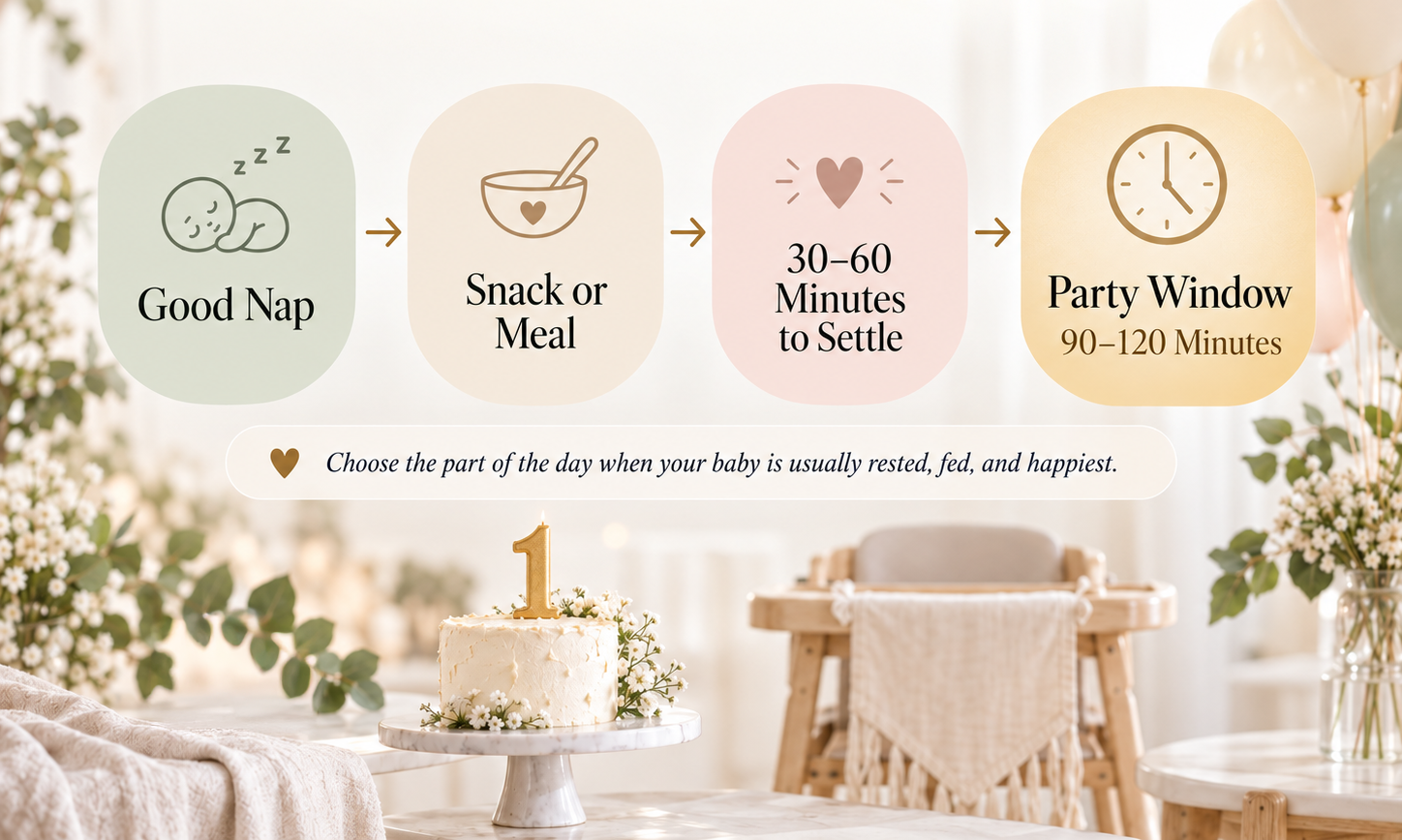
A simple way to find your baby’s best first birthday party window: start after a good nap and meal, allow a little time to settle, then plan for about 90 minutes to two hours.
For many families, a mid-morning or mid-afternoon party works beautifully.
But the actual clock matters less than what happens immediately before the party.
Think about your baby's happiest stretch of the day.
When have they usually:
finished a good nap
had something to eat
had time to wake up and get comfortable
still have plenty of time before the next nap or bedtime
That is your strongest party window.
A baby who normally wakes from a morning nap at 10:00 may do wonderfully with an 11:00 birthday party.
Another child may be happiest after a long midday nap, making 2:30 or 3:00 a much better choice.
The goal is not to choose the most convenient time on the clock. It is to choose the part of the day when your baby is most likely to enjoy their own celebration.
Morning or Afternoon: Which Is Better?
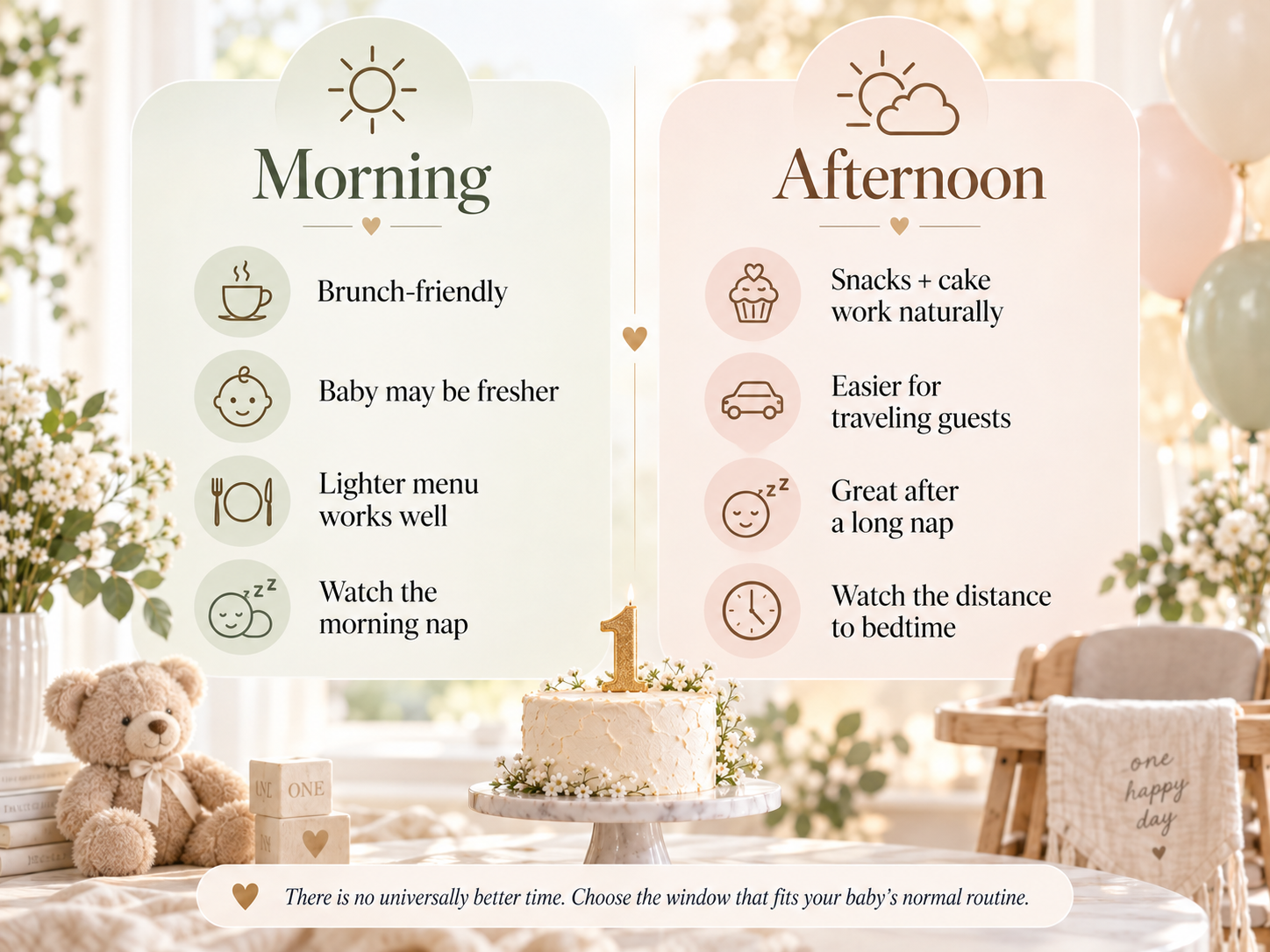
A side-by-side look at morning and afternoon first birthday parties, with the strengths of each and the scheduling details to watch before choosing your baby's best party window.
Both can work. The better choice depends on your baby's normal routine and the kind of party you want to host.
A Morning First Birthday Party
Morning celebrations can be wonderful for babies who wake cheerful and have a reliable morning routine.
They also lend themselves naturally to lighter food.
Coffee, muffins, pastries, fruit, mini sandwiches, pancakes, yogurt, and a small birthday cake can make a lovely brunch-style celebration without requiring a full lunch or dinner.
Morning parties can also help you avoid the late-afternoon stretch when some babies begin getting tired long before bedtime arrives.
The main thing to consider is the morning nap.
If your baby regularly sleeps from 9:30 until 10:30, an invitation that says 10:00 AM may be setting everyone up for a stressful morning.
Let the nap happen first.
Then celebrate.
An Afternoon First Birthday Party
An afternoon party can work especially well for a baby who takes one longer midday nap or who is consistently cheerful after an afternoon rest.
It can also be easier for grandparents, relatives, or friends who need to travel to the party.
The biggest thing to watch is bedtime.
A 4:00 PM party may sound perfectly reasonable until you realize that your baby normally eats dinner at 5:00 and begins winding down for bed shortly afterward.
Try to leave some breathing room between the party and the bedtime routine.
If Your Baby Still Takes Two Naps
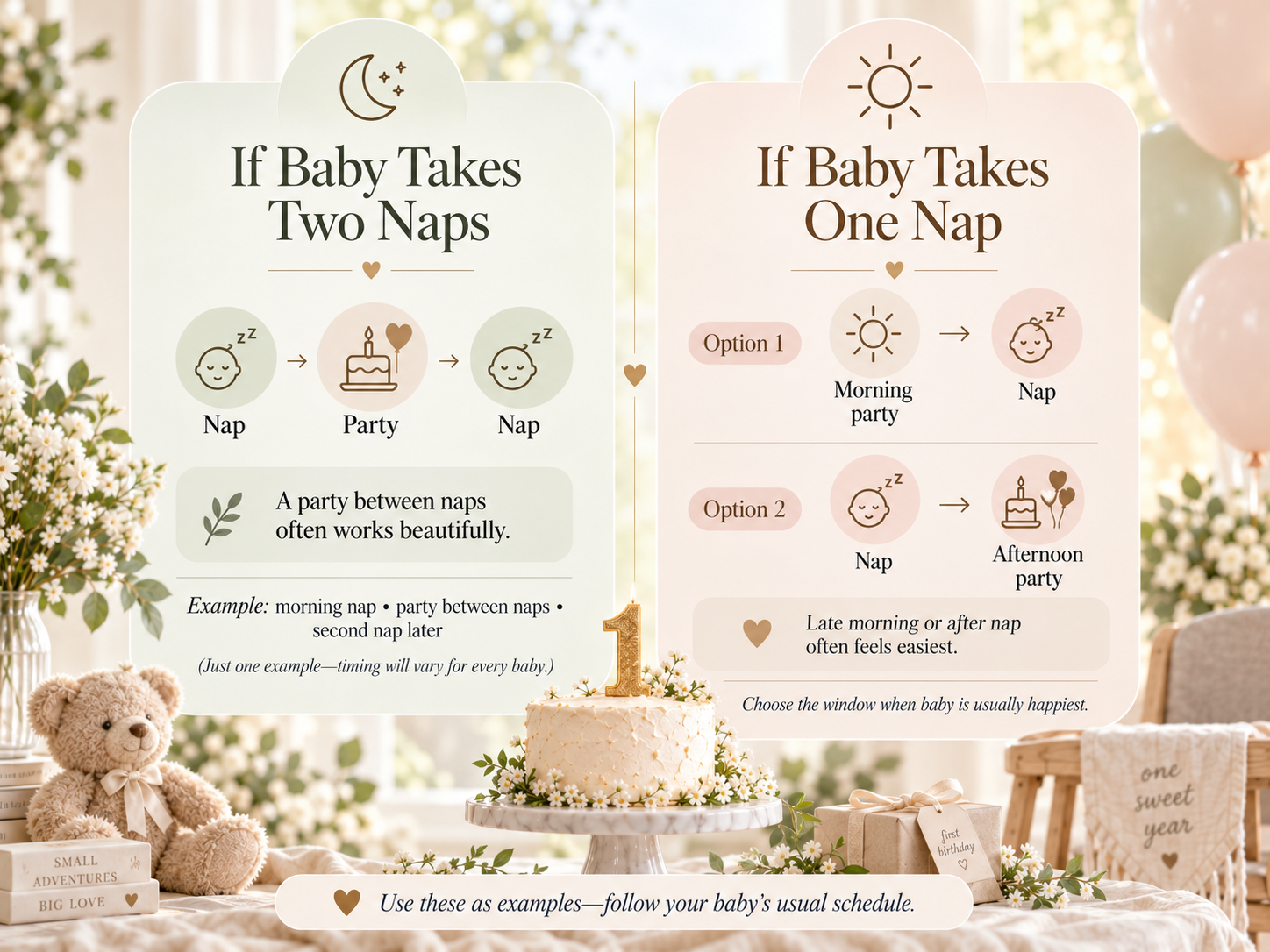
A simple visual guide to planning a first birthday around your baby’s nap schedule, with one example for babies taking two naps and two easy options for babies taking one nap.
This is where choosing a first birthday time can feel especially complicated.
Rather than trying to squeeze a party into the baby's usual nap time, look for the most dependable awake window between the two naps.
For example, if your baby wakes from the first nap around 10:00 and usually stays happily awake until 1:00, an 11:00 AM to 12:30 PM party may fit beautifully.
If the second nap is more predictable, you may prefer to wait until afterward.
There is no rule that first birthday parties have to happen at lunchtime.
A 3:00 PM celebration with cake, snacks, drinks, and family can be every bit as special.
If Your Baby Has Moved to One Nap
Once a baby moves toward one longer midday nap, the middle of the day can become a difficult party window.
In that situation, you may find that either late morning before the nap or mid-afternoon after the nap works better.
The important thing is not to schedule the birthday directly across the time your child usually sleeps simply because noon seemed like the most traditional party time.
The party is much more likely to feel relaxed if your baby arrives rested instead of already running on borrowed time.
What If the Nap Schedule Changes Before the Birthday?
This is one of the hardest parts of planning a first birthday several weeks in advance.
A baby's schedule in August may not look exactly the same by October.
So avoid building your entire party around an extremely precise sleep schedule that may change before the invitations are even opened.
Instead, choose a general part of the day that is usually successful for your baby.
If mornings are consistently better than afternoons, choose morning.
If your baby has always been happiest after the midday nap, choose afternoon.
And most importantly, leave some flexibility inside the party itself.
Cake does not have to happen at exactly 1:47.
Photos do not have to happen at exactly 2:05.
A first birthday works best when the schedule gives you structure without turning the day into a race against the clock.
How Long Should a First Birthday Party Last?
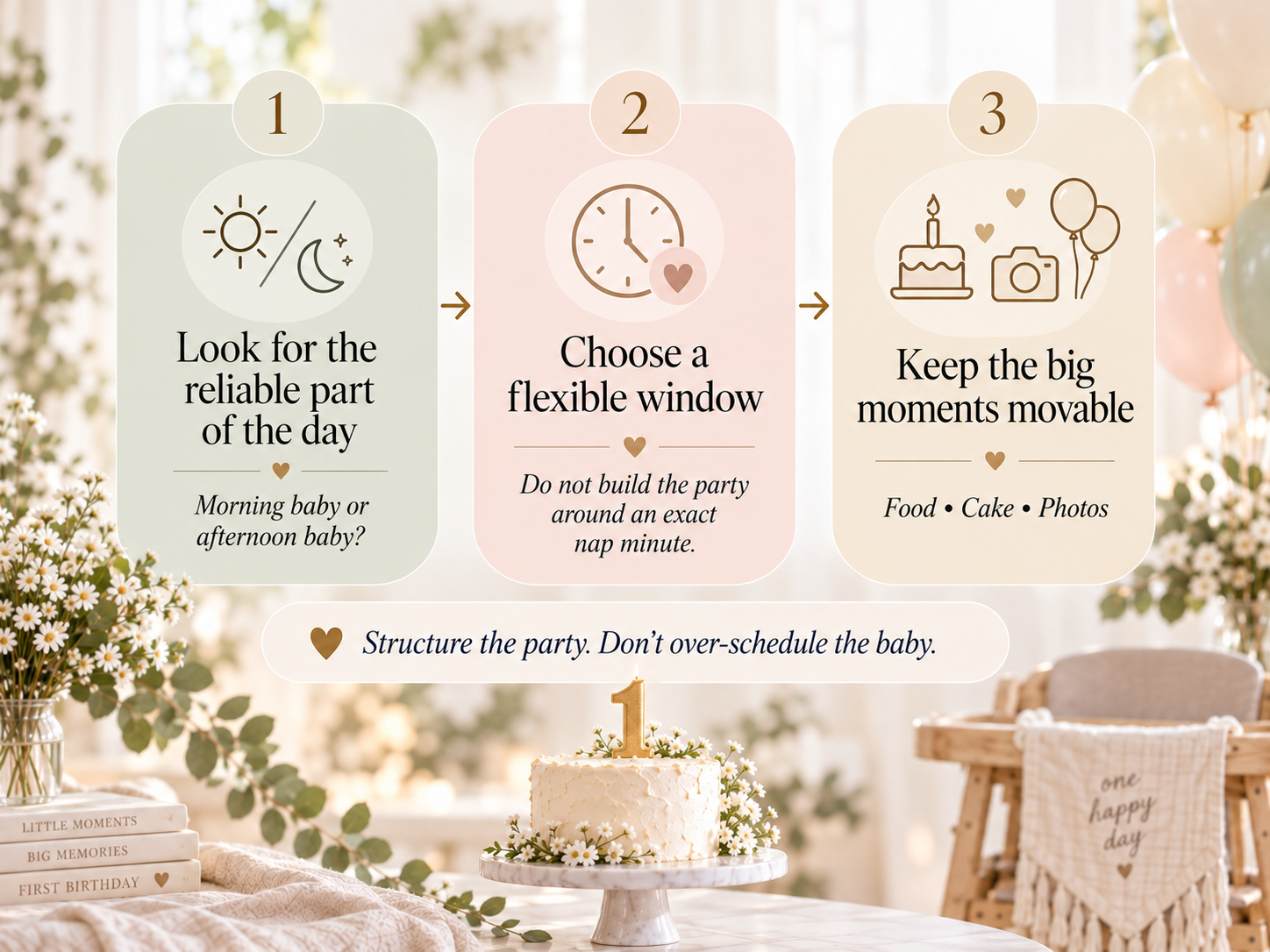
A flexible way to plan a first birthday weeks ahead: choose the most reliable part of your baby’s day, leave room for nap changes, and keep food, cake, and photos easy to move.
For most one-year-olds, 90 minutes to two hours is plenty.
Adults may be able to happily socialize for four hours.
A one-year-old usually has very different plans.
A shorter party gives everyone time to visit, eat, take photographs, sing Happy Birthday, enjoy cake, and celebrate without expecting the birthday baby to entertain a room full of people for an entire afternoon.
A 90-Minute Party Works Well When…
The guest list is fairly small.
You're serving cake, snacks, or brunch rather than a full meal.
There are not many structured activities.
Most guests are family or close friends.
A Two-Hour Party Works Well When…
You have a larger guest list.
You're serving lunch or a more substantial meal.
Guests are traveling farther.
You want a little more time for photographs, presents, or visiting.
Longer is not automatically better.
If adults want to linger after the main celebration, that's fine. The important thing is that the baby's participation does not depend on staying cheerful for three or four hours.
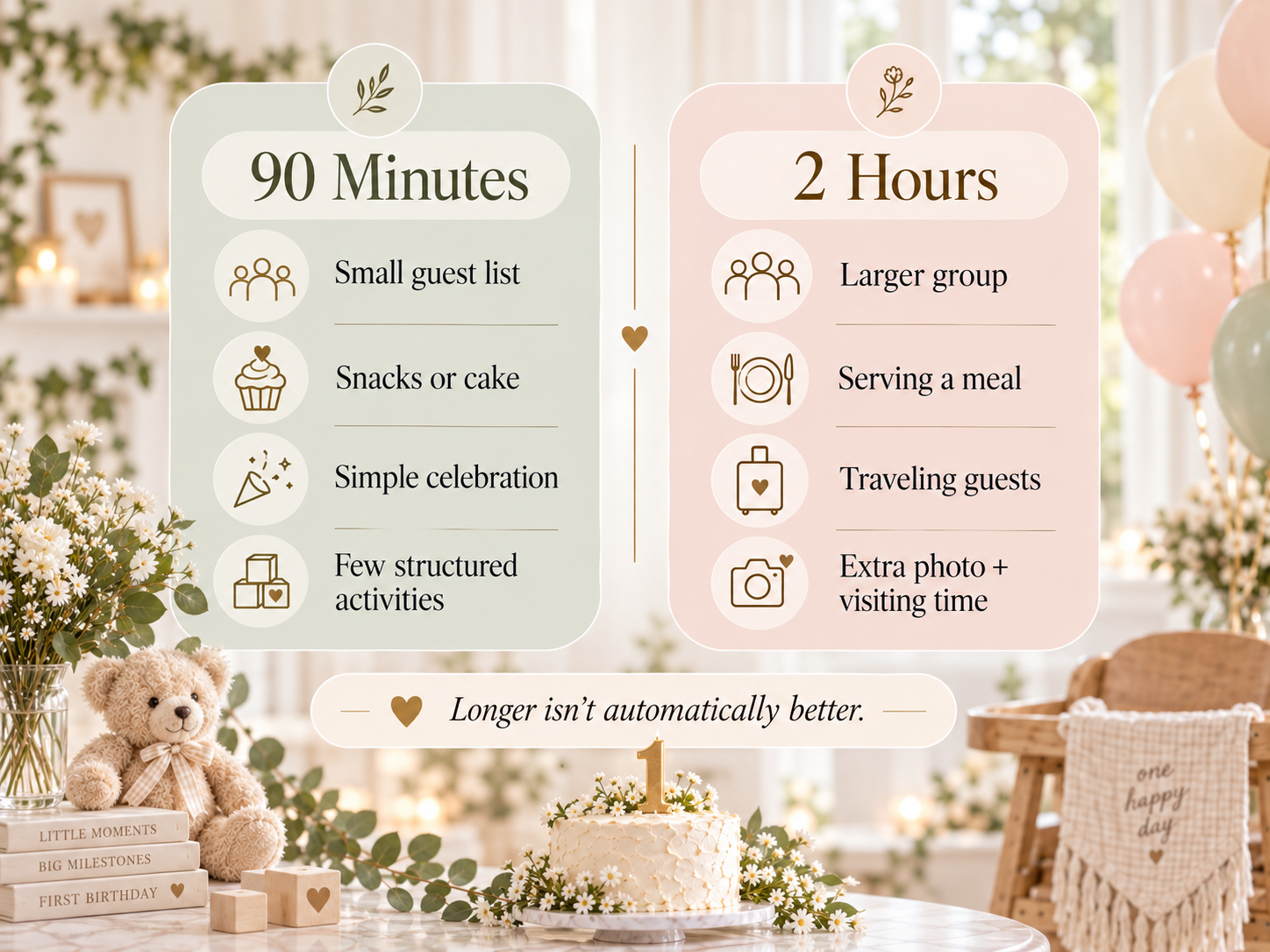
Choose 90 minutes for a smaller, simpler first birthday, or allow two hours when you’re serving a meal, hosting more guests, or want extra time for photos and visiting.
A Simple 90-Minute First Birthday Schedule
You do not need to fill every minute.
In fact, first birthday parties often feel better when there is plenty of unstructured time built in.
0:00–0:15 — Guests arrive
Give everyone time to come in, grab a drink, greet the birthday baby, and settle down.
0:15–0:35 — Visit, play, and take casual photos
This gives your baby time to get comfortable before everyone suddenly gathers around them.
0:35–0:55 — Food or snacks
Serve the main food while your baby is still happy and settled.
0:55–1:10 — Happy Birthday and cake
This is early enough that you are not saving the biggest moment for the very end of your baby's tolerance.
1:10–1:20 — Photos and relaxed visiting
Take family photographs, clean up the birthday baby, and let everyone enjoy the last few minutes together.
1:20–1:30 — Favors and goodbyes
Guests can begin leaving naturally without the party feeling abruptly finished.
A Relaxed Two-Hour First Birthday Schedule
If you're serving a meal or expecting more guests, give yourself a little more room.
0:00–0:20 — Guests arrive and mingle
0:20–0:50 — Food
0:50–1:15 — Visiting, simple activity, or photos
1:15–1:35 — Happy Birthday and cake
1:35–1:50 — Gifts, photos, or relaxed play
1:50–2:00 — Favors and goodbyes
You can move almost any part of this schedule around.
That is the point.
A good first birthday schedule should make the day easier, not create another set of rules to follow.
If you’re planning the rest of the celebration too, my First Birthday Planning Journal includes a party-day timeline along with pages for your guest list, menu, budget, decorations, and more.
When Should You Do the Smash Cake?
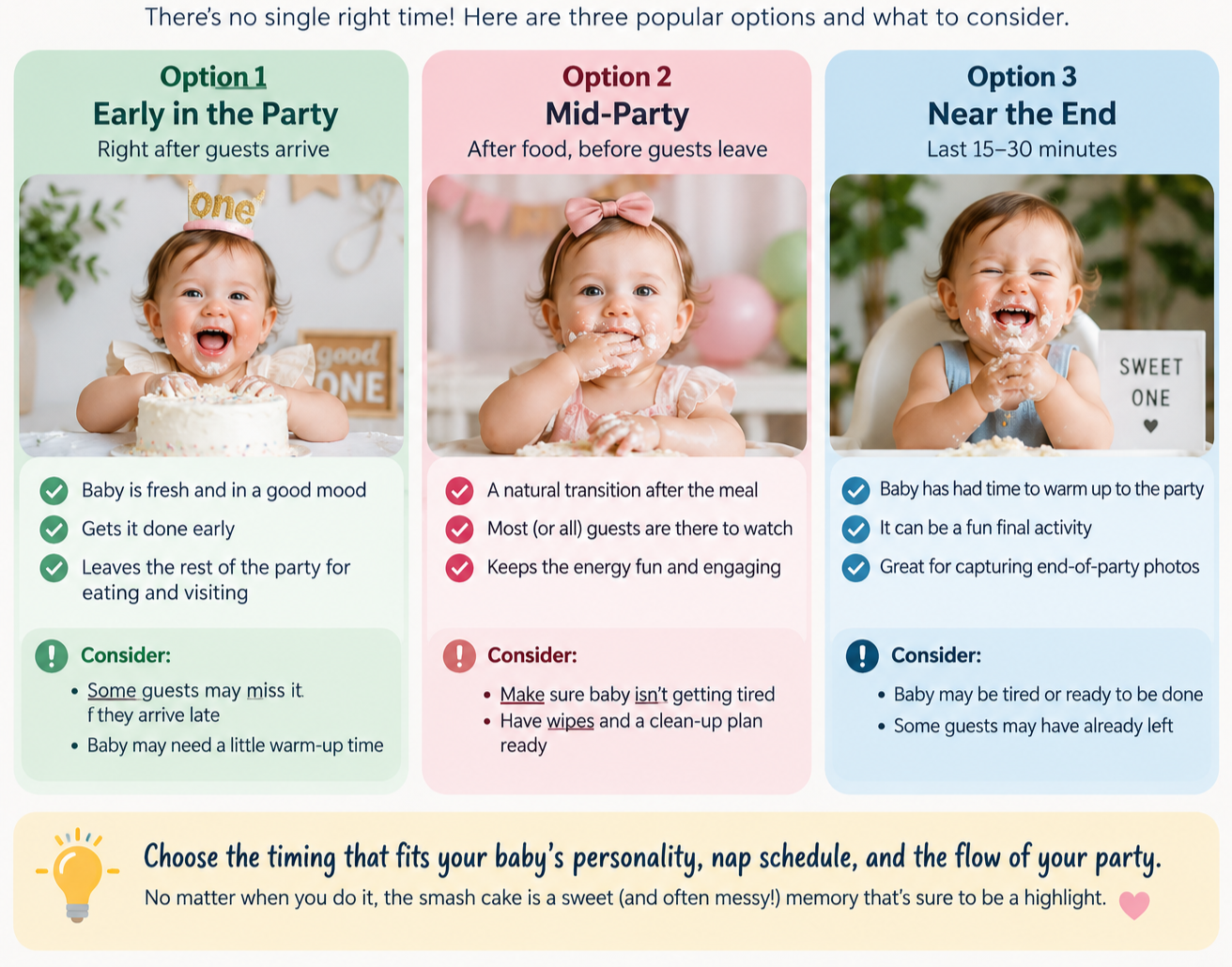
Three easy ways to time the first birthday smash cake: early while baby is fresh, mid-party after guests have settled in, or near the end as a fun finale.
Try not to save the cake smash for the final five minutes of the party.
By then, your baby may have been passed around, photographed, entertained, fed, and admired by every relative in the room.
If the cake smash or birthday cake is one of the moments you care most about, schedule it while your baby still has some energy left.
After everyone has arrived and eaten is often a comfortable time.
Your baby has had time to adjust to the room, but you have not yet pushed too close to the next nap or bedtime.
And if your baby's mood starts fading earlier than expected?
Move the cake up.
Nobody will complain that cake happened too soon.
What If Your Baby Naps Through Part of the Party?
Let them sleep.
There is no prize for waking an exhausted one-year-old because fifteen people are waiting to sing Happy Birthday.
Guests can eat.
Adults can visit.
Grandparents can catch up.
You can move photos and cake until after the baby wakes.
A first birthday is one of those celebrations where flexibility is not a sign that the plan failed.
It is often what makes the plan work.
What About the Other Babies' Nap Schedules?
If several babies or toddlers are attending, there probably will not be one start time that works perfectly for everyone.
That is okay.
Choose the time that works best for the birthday child.
Parents of young children already understand that naps vary, and some guests may arrive a little late or leave a little early.
You are hosting a first birthday—not coordinating air traffic.
When Should You Serve Food?
This depends partly on the time printed on the invitation.
Guests will usually assume a party held around noon or dinner time includes a more substantial meal.
A 10:30 AM party can easily become brunch.
A 2:30 or 3:00 PM party works beautifully with lighter snacks, fruit, desserts, drinks, and cake.
That can also help keep the celebration simpler and more affordable.
If you're trying to avoid preparing a full meal for a large guest list, choosing a time between traditional meal periods can make that expectation much clearer.
When Should You Open Gifts?
You do not have to.
With a small family party, opening a few presents can be sweet.
With a larger guest list, it can take a significant amount of time and may be more interesting to the adults than the birthday baby.
If your child is getting tired, skip the gift-opening portion and enjoy the remaining time together.
You can always open presents later at home and send photographs or personal thank-you notes afterward.
Should You Put an End Time on the Invitation?
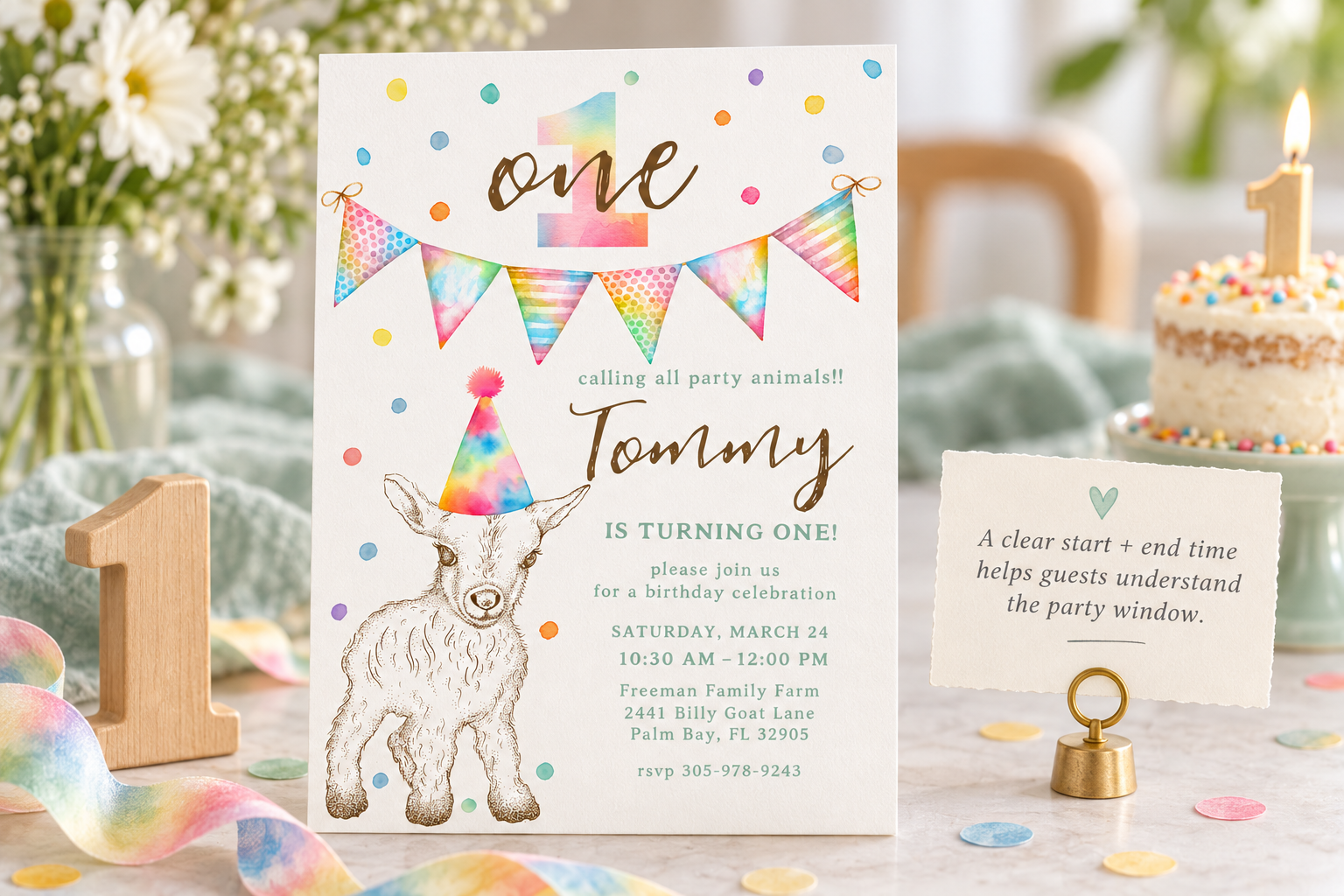
Showing a clear start and end time on a first birthday invitation can help guests understand that the celebration is intentionally short and built around the birthday baby’s routine.
For a first birthday, I think it can be surprisingly helpful.
Instead of:
Saturday, October 17 at 10:30 AM
consider:
Saturday, October 17
10:30 AM–12:00 PM
An end time gently tells guests that this is a shorter celebration designed around a young child's routine.
It can also make planning easier for guests who have their own children, naps, activities, or family commitments that day.
Once you've found the time that works best, your invitation becomes one of the easiest ways to make that plan clear.
This is also where choosing a coordinated first birthday invitation and party pieces can simplify things. Once the time, date, location, and general feel of the party are decided, the rest of the celebration can begin falling into place.
What If Everything Goes Wrong Anyway?
The nap is late.
The birthday baby refuses lunch.
Someone spills something on the outfit five minutes before the photographs.
The cake smash lasts twelve seconds.
Half the guests arrive late.
This is still a successful first birthday.
The schedule is there to give the day a little rhythm, not to determine whether the celebration was good enough.
Your baby will not remember whether cake happened twenty minutes later than planned.
But the people who love them will remember gathering in one place to celebrate an entire first year.
First Birthday Party Timing FAQ
What is the best time of day for a first birthday party?
Choose the part of the day when your baby is normally rested, fed, and happiest. Mid-morning and mid-afternoon are often convenient options, but your child's normal routine matters more than a specific clock time.
Is 10 AM too early for a first birthday party?
Not necessarily. A 10:00 or 10:30 morning party can be wonderful if it works with your baby's nap schedule. It also lends itself well to brunch-style food.
Is 1 PM a good time for a first birthday party?
It can be, but check your baby's routine first. For many one-year-olds, early afternoon overlaps with a nap or comes immediately after lunch, so another time may work better.
How long should a first birthday party be?
About 90 minutes to two hours is usually enough time for guests to arrive, eat, visit, take photos, enjoy cake, and celebrate without making the day too long for the birthday baby.
Should a first birthday party be before or after a nap?
After a dependable nap is often the easier choice because your baby starts the party rested. But if your child has a long midday nap, a morning celebration before that nap may work better.
What time should cake happen at a first birthday?
Try to serve cake after guests have arrived and had time to settle, but before your baby reaches the tired part of the party. Do not feel obligated to save cake for the very end.
Do you need activities at a first birthday party?
Usually not many. At this age, visiting, food, photographs, cake, and simple play are often enough. A room full of structured games can be more exhausting than helpful.
Planning the Rest of the First Birthday
Once you've chosen the time, everything else becomes a little easier.
You can decide whether you're serving brunch, lunch, or snacks. You know how much of the day you actually need to fill. You can choose invitations with a clear start and end time. And you can build the party around the moments you care about most instead of trying to squeeze every birthday tradition into one afternoon.
If you're still working through the rest of the details, our First Birthday Planning Journal can help you organize everything from the guest list and budget to decorations and the party-day plan.
And if you haven't chosen the celebration itself yet, browse our First Birthday Party Theme Ideas for inspiration that can help everything begin to feel connected.
A first birthday does not need to be the longest, busiest, or most elaborate party your family has ever hosted.
It just needs enough time for the people who love your little one to gather, celebrate, take too many pictures, eat a little cake, and mark one very special year.
Choose the window when your baby is most likely to feel like themselves—and build the party around that.
Love,
Leska
