
Before ordering invitations for a baby shower, bridal shower, birthday party, or holiday gathering, there's one number worth double-checking.
It's probably not the number on your guest list.
You usually need one invitation for each person, couple, or family group receiving an invitation—not one for every person attending. Then you'll want a few extras for last-minute additions, mistakes, and keepsakes.
For example, a party with 40 invited guests might only need 25 invitations, depending on how those guests are grouped.
Here's how to find the right number for your celebration.
Why Your Guest Count Isn't Your Invitation Count
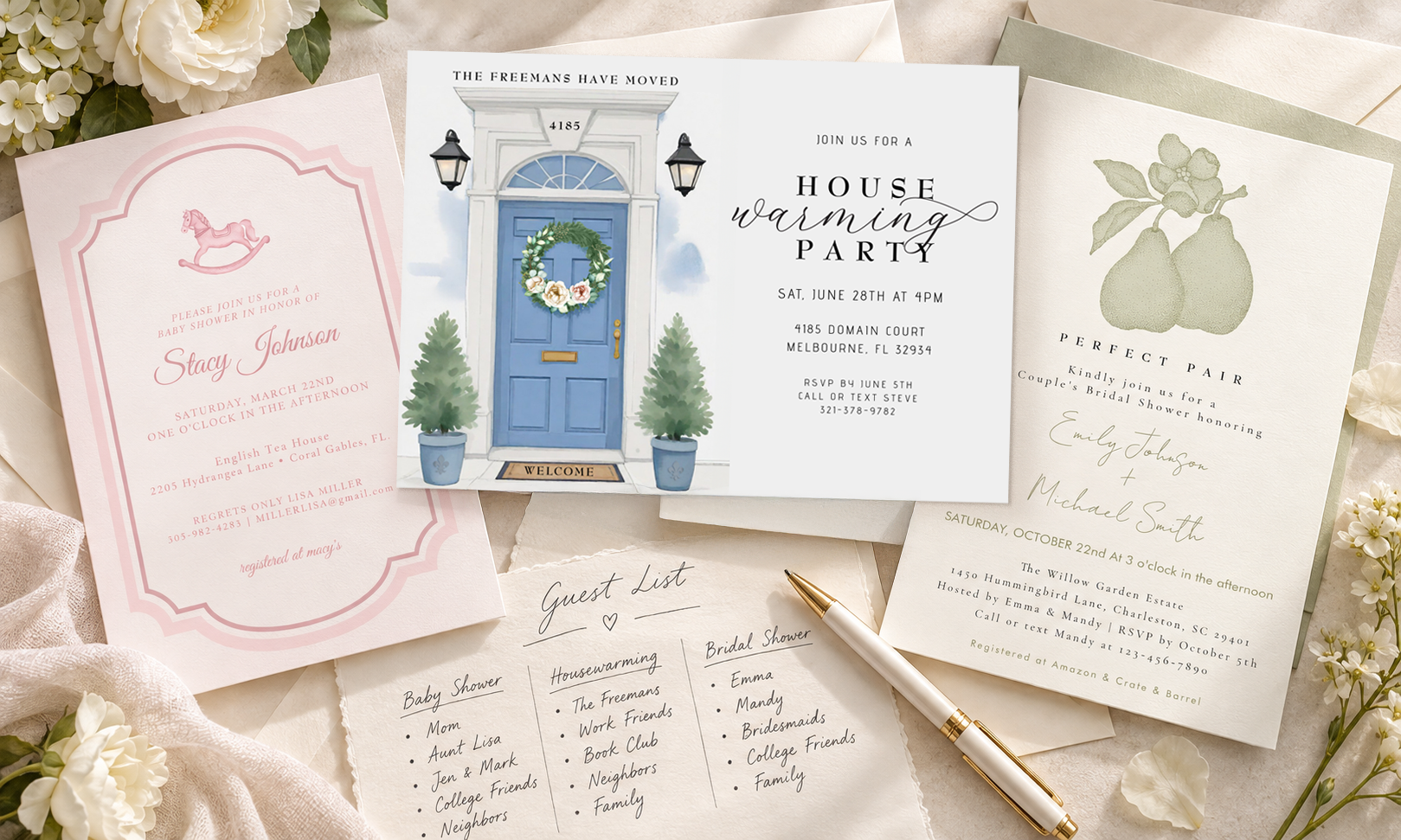
From baby showers to bridal showers and housewarming parties, the right invitation quantity starts with your guest list—not simply your guest count.
Your guest count tells you how many people you're inviting. Your invitation count tells you how many invitations you need to deliver.
They serve two different purposes.
Imagine you're inviting your sister, her husband, and their two young children to a birthday party. That's four guests, but you would typically send one invitation addressed to the family.
Now imagine you're inviting three coworkers who each live separately. That's three guests and three invitations.
For planning food, seating, favors, and activities, all seven people count toward your guest total.
For ordering invitations, you may only need four.
The simplest approach is to count invitation recipients rather than individual guests.
How to Calculate How Many Invitations You Need

Seven guests don't necessarily mean seven invitations. One family of four can share an invitation, while three individually invited guests each receive their own—bringing the total to just four invitations.
You don't need a complicated formula or an estimate based on averages. You need your actual guest list.
Step 1: Write down everyone you're inviting
Include adults, children, partners, and any other guests you're extending an invitation to.
Count everyone you're inviting, not just those you expect to accept. You won't know your final attendance until RSVPs arrive.
Step 2: Group guests who will share an invitation
Go through the list and determine who will receive an invitation together.
A married couple might share one. Parents and their young children might share another. A friend living alone would receive their own.
Keep adults who should be invited independently as separate recipients, even if they live at the same address.
Each resulting recipient group represents one invitation to deliver.
Step 3: Add a few extra copies
Once you know how many invitations you'll send or hand out, add a small allowance for unexpected needs.
Your formula is:
Invitations to order = Invitations to deliver + Extra copies
How Many Invitations Do You Need for 20, 40, or 60 Guests?
The number of invitations you need depends less on the size of your guest list and more on how those guests are grouped.
Consider these three examples:
A baby shower with 20 invited guests
Your guest list includes five couples, two families of three, and four individually invited friends.
5 couples = 5 invitations (10 guests)
2 families = 2 invitations (6 guests)
4 individuals = 4 invitations (4 guests)
Total: 11 invitations, plus 3 extras = 14 invitations to order.
A bridal shower with 40 invited guests
Most guests are being invited individually, but a few family members and couples will share invitations.
24 individuals = 24 invitations (24 guests)
5 couples = 5 invitations (10 guests)
2 families of three = 2 invitations (6 guests)
Total: 31 invitations, plus 4 extras = 35 invitations to order.
A birthday party with 60 invited guests
This celebration includes several couples and families, so fewer invitations are needed than the total headcount might suggest.
8 individuals = 8 invitations (8 guests)
8 couples = 8 invitations (16 guests)
9 families of four = 9 invitations (36 guests)
Total: 25 invitations, plus 4 extras = 29 invitations to order.
Here's how those examples compare:
How the Three Celebrations Compare
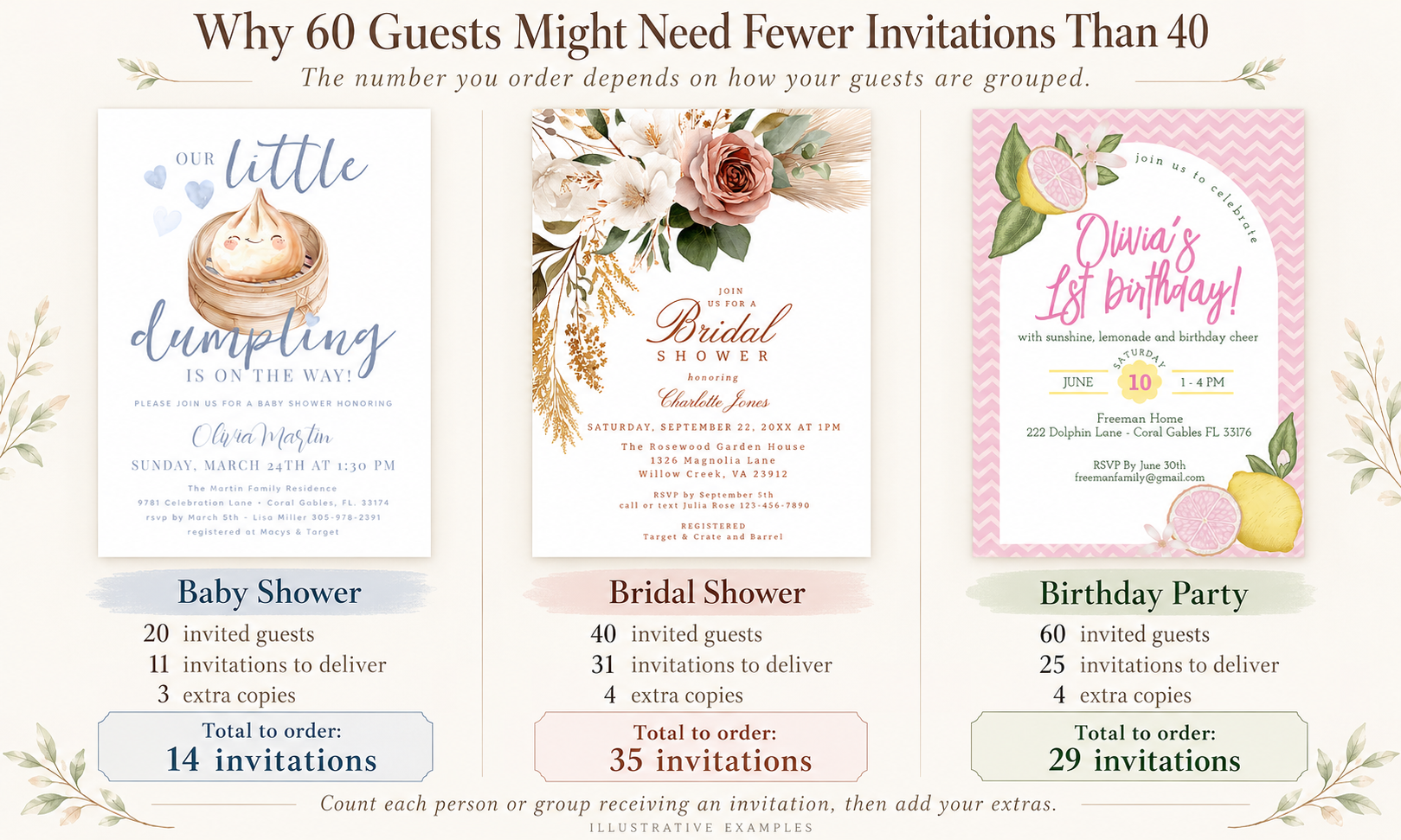
A larger guest list doesn't always mean a larger invitation order. What matters most is how your guests are grouped—by couples, families, or individually invited recipients.
Baby Shower — 20 Guests
11 invitations to deliver
3 extra copies
Total to order: 14 invitations
Bridal Shower — 40 Guests
31 invitations to deliver
4 extra copies
Total to order: 35 invitations
Birthday Party — 60 Guests
25 invitations to deliver
4 extra copies
Total to order: 29 invitations
These are illustrative examples. Your actual quantities depend on your guest list, who should receive invitations together, and how many extras you choose to keep.
Notice that the 60-person birthday party requires fewer printed invitations than the 40-person bridal shower.
That's why dividing your guest count in half isn't a reliable ordering method. Count each person or group receiving an invitation first, then add your extras. You'll have a much more accurate number before placing your order.
Free Printable: My Invitation Order Planner
Ready to calculate your own invitation quantity? I've created a simple worksheet to help you organize your guest list, group recipients who can share an invitation, and account for extra copies before ordering.
Download the Free Invitation Quantity Worksheet
Print it out, grab a pen, and work through your guest list at your own pace. You'll have a much clearer idea of exactly how many printed invitations you need.
Who Should Receive Their Own Invitation?
For most casual celebrations, couples and families can share an invitation. But sharing an address doesn't always mean sharing an invitation.
Here's how to handle the situations that tend to create confusion.Couples living together
One invitation addressed to both people is generally appropriate when both are invited.
For example:
Jordan and Taylor Morgan
There's usually no need to order two copies simply because two adults are attending together.
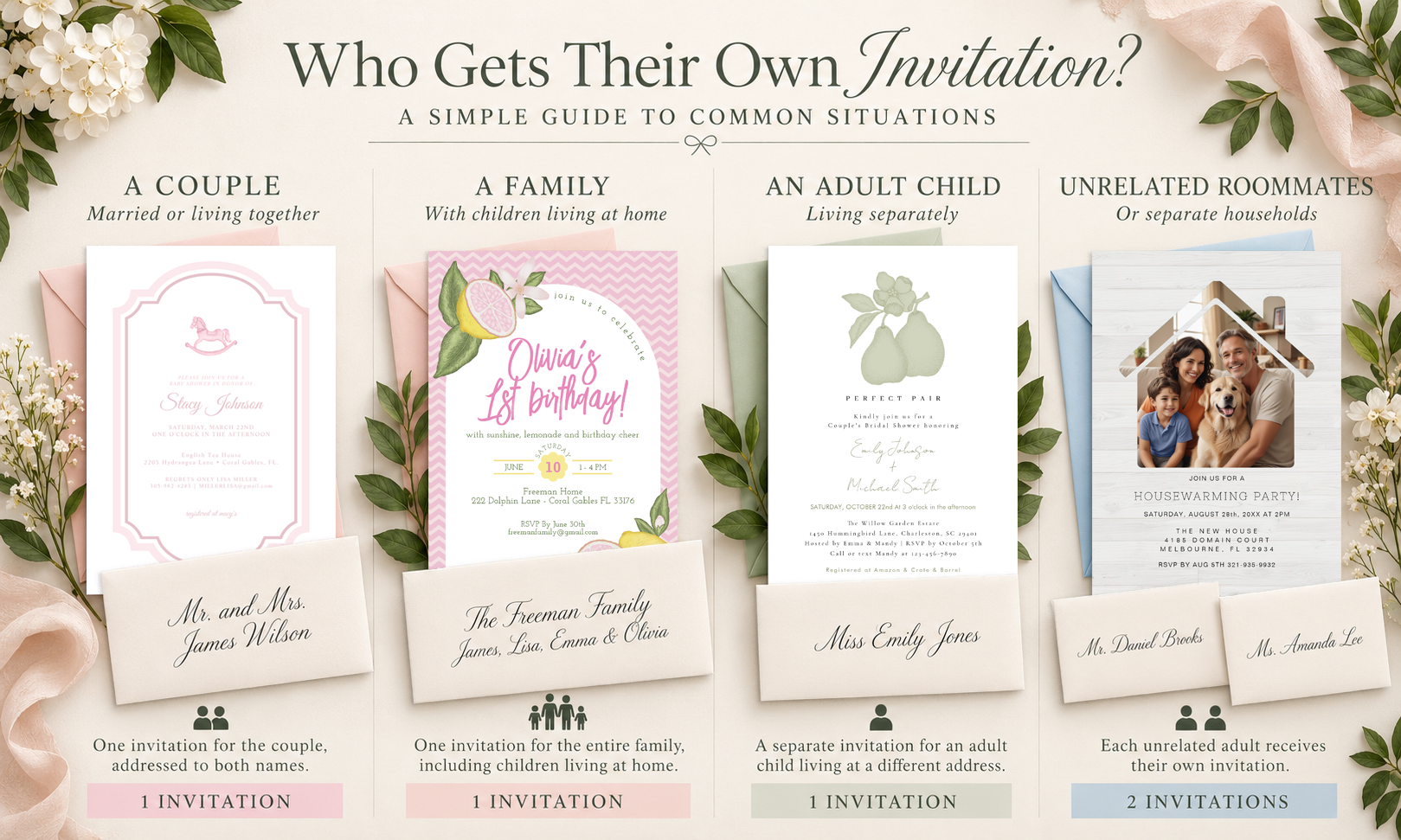
One address doesn't always mean one invitation. Couples and families can often share, while adult children and unrelated roommates may need their own. Use these common situations to help determine your invitation count.
Families with children
When parents and their young children are all invited, one invitation addressed to the family is generally enough.
For example:
The Morgan Family
Or list the invited family members by name if you want to make exactly who is included clearer.
If children aren't invited, address the invitation to the adults rather than the entire family.
Adult children living with their parents
An adult child who lives at home may deserve a separate invitation, particularly for a more formal event or when they're being invited independently.
For a casual family birthday, one invitation might still make sense.
Consider the nature of the celebration and how the guests are being invited instead of applying an absolute rule.
Friends or roommates sharing an address
Two roommates aren't automatically one invitation group.
If they're independent friends receiving separate invitations, count two copies—even though they'll arrive at the same mailbox.
The mailing address doesn't determine the invitation quantity. The intended recipient does.
Guests receiving invitations separately
Sometimes you may choose to invite people individually even when they're part of the same family.
For example, a mother and her adult daughter may both be invited to a bridal shower in their own right.
One shared invitation could be perfectly appropriate for an informal gathering, but individual invitations may feel more personal.
Make that decision before finalizing your order.
A useful test: If you were handing out the invitations in person, would you naturally give these people one card together or separate cards?
That often clarifies the answer.
How Many Extra Invitations Should You Order?
For many printed invitation orders, approximately 10–15% extra is a reasonable starting point. But the right number depends on the size and circumstances of your celebration.
For a small baby shower requiring only 12 invitations, adding two copies might feel a little tight. Three to five extras may offer more flexibility.
For a larger party requiring 60 invitations, six to nine extras might be a sensible allowance if your list is reasonably settled.
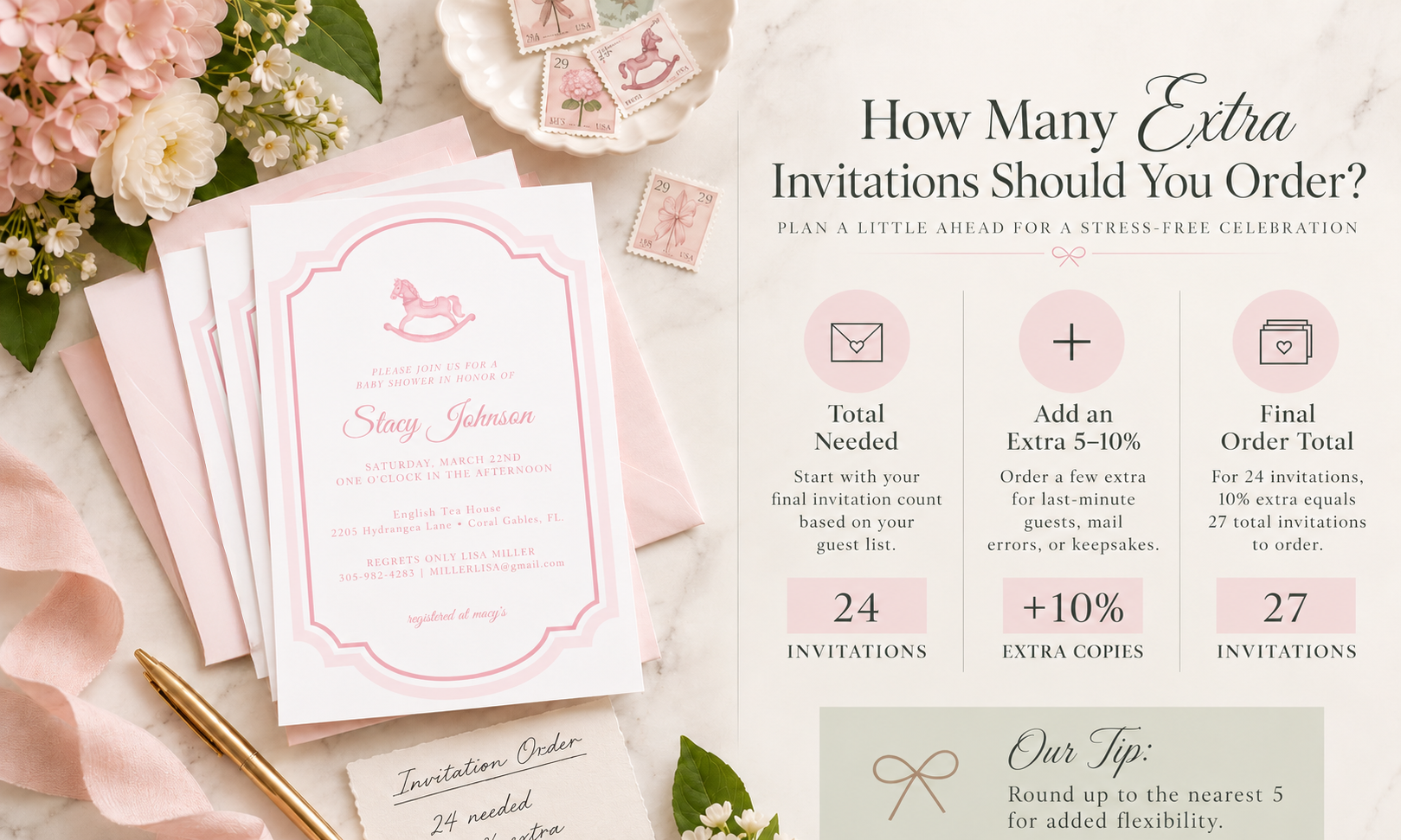
A few extra invitations can make all the difference. Start with the number you actually need to deliver, then add a small allowance for last-minute guests, addressing mistakes, and keepsakes.
Extra copies can help with:
A guest you accidentally left off the list
Last-minute additions
An invitation lost or damaged in the mail
A typo discovered while addressing envelopes
A keepsake for the guest of honor or family
A clean copy for photographs or a memory album
Keep in mind that an addressing mistake usually ruins an envelope, not the invitation itself. Check whether spare envelopes are included or can be ordered separately.
Also look at the seller's available quantities and prices. If invitations are sold in particular order increments, your final purchase may need to be rounded up.
You don't need to buy dozens of unnecessary extras. Just leave yourself enough room that one small change doesn't require another order.
When Should You Order Printed Invitations?
The best ordering date depends on when guests need to receive their invitations, how much personalization is involved, and how long printing and delivery will take.
For many casual birthday parties, giving guests around three to four weeks' notice is a useful starting point. Baby showers and bridal showers may benefit from four to six weeks, especially when guests need to arrange travel or childcare.
These are planning guidelines, not strict etiquette deadlines.
To choose an ordering date, work backward:
Decide when you want guests to receive their invitations.
Allow time for addressing and mailing or handing them out.
Check the printer's current production and shipping estimates.
Leave a little breathing room for unexpected delays.
Proofread the personalized design before placing the order.
For customized invitations from Chateau Whispers on Zazzle, check the delivery estimate for the specific product and shipping selection rather than assuming every invitation has the same turnaround time.
And don't wait until you've chosen every centerpiece or dessert. Once your date, location, guest list, and invitation details are confirmed, you can move forward.
What If You're Sending Both Printed and Digital Invitations?
You may not need printed invitations for everyone.
Perhaps your local guests will receive printed cards while relatives who live far away prefer digital invitations. Or you might print invitations for family members who appreciate having something tangible and send others electronically.
That's perfectly workable.
Divide your recipient list into printed and digital groups, making sure everyone receives the invitation in their preferred format.
Then calculate the printed quantity using only the recipients receiving physical invitations.
If a family receives one printed invitation and a digital reminder later, that still counts as one printed invitation.
Be mindful of duplicate invitations and track responses in one place, whether people RSVP by text, email, phone, or an online form.
Your Invitation Order Checklist
Before placing your order, check each of these details:
Everyone you intend to invite is on your guest list.
Couples and families sharing invitations are grouped appropriately.
Adults or roommates receiving separate invitations have their own entries.
Your printed invitation total is separate from your overall guest count.
You've added a reasonable number of extras.
You have enough envelopes and any coordinating details or RSVP cards you need.
Names, dates, times, addresses, and RSVP details are correct.
You've checked the available order quantities and delivery estimates.
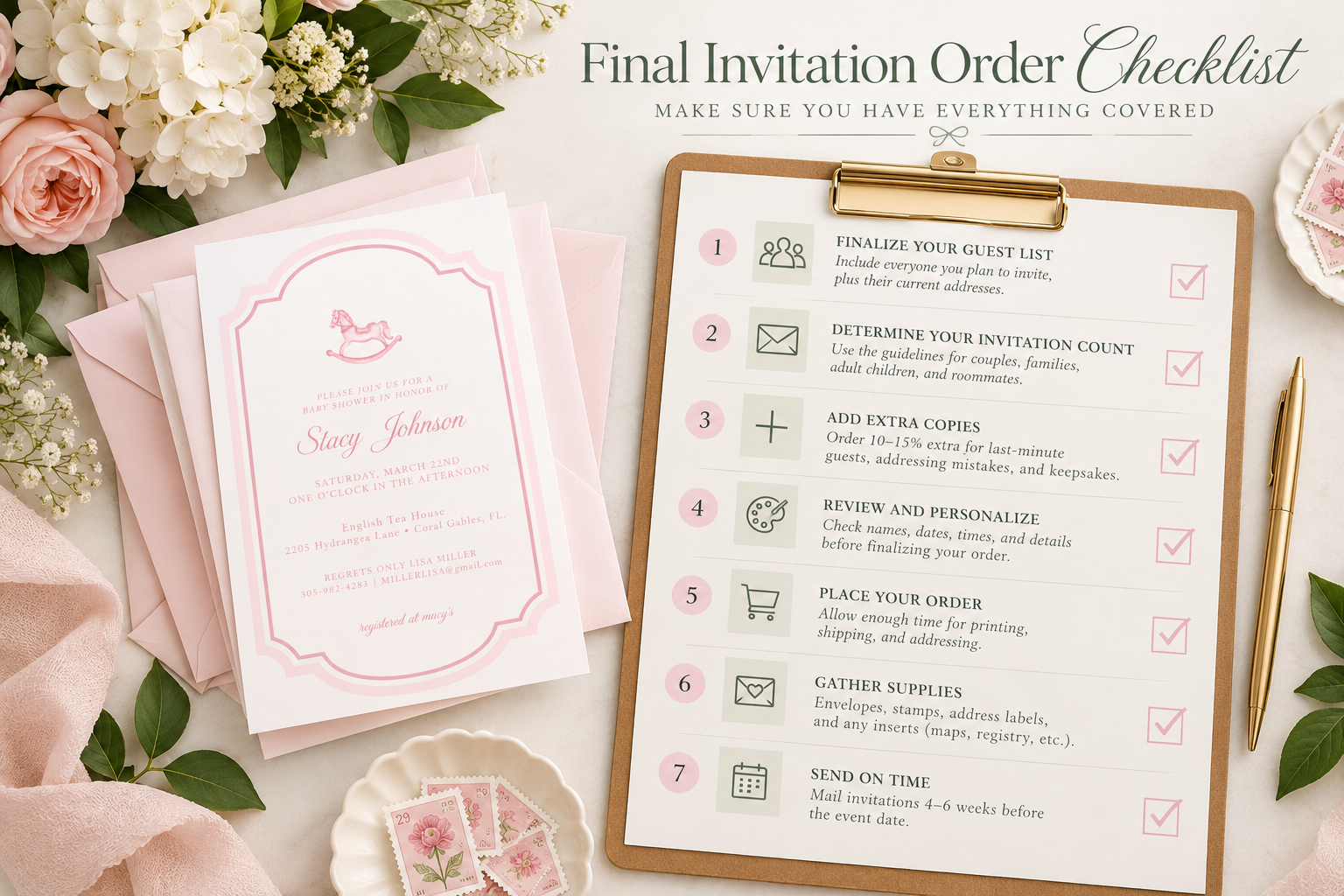
Before ordering your invitations, take a moment to double-check your guest list, invitation quantity, extra copies, personalized details, and delivery timeline. A little preparation now can help avoid last-minute surprises.
If you're planning a bridal shower, our Bridal Shower Invitation Wording Guide can help you decide what information belongs on the main invitation and what might be better placed on a separate details card.
For a baby's first birthday, start with our First Birthday Guest List Guide if you're still deciding whom to include.
Order for the People You're Inviting, Not Just the Number on Your List
The easiest way to avoid over ordering or running short is to think about how your invitations will actually be delivered.
Count the people and groups receiving their own invitations, add a few extras, and check your final quantity before checkout.
Whether you're inviting 20 people to an intimate baby shower or 60 people to a backyard birthday celebration, the same method works.
Once you've settled the count, you can choose an invitation that suits the celebration. Explore the Chateau Whispers invitation designs whenever you're ready.
One less decision to second-guess—and one more piece of the party planned.
I've always believed that planning a celebration should feel enjoyable, not overwhelming. Sometimes it's the smallest details, like figuring out how many invitations to order, that leave us second-guessing ourselves.
My hope is that this little guide takes one more decision off your plate, so you can spend less time worrying about getting everything right and more time looking forward to bringing everyone together.
Because in the end, it's not about how many invitations you send. It's about the people you're inviting and the memories you'll make together.
With love,
Leska
Chateau Whispers
